ABV Calculator (Alcohol by Volume)
Enter the original and final gravity to get the alcohol by volume, alcohol by weight and attenuation.
How to use the ABV calculator
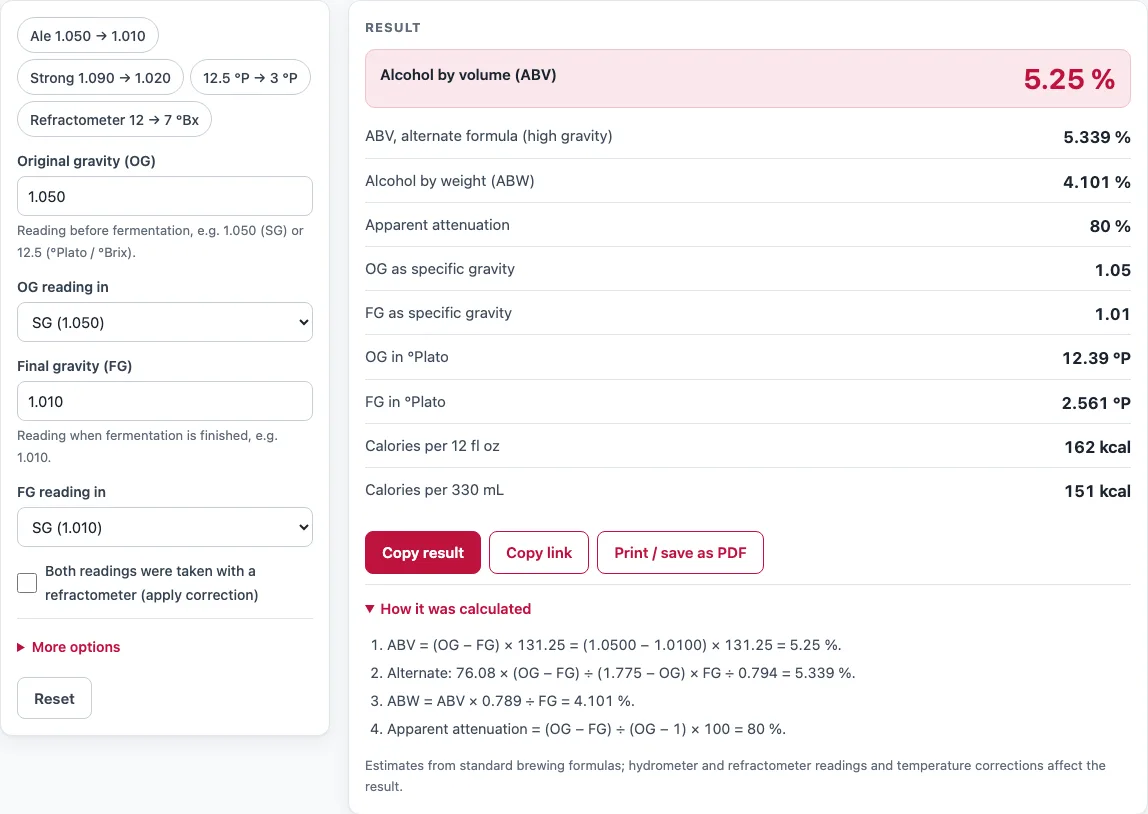
- Type your original gravity into “Original gravity (OG)”, for example 1.050. The page starts with 1.050 and 1.010.
- Set “OG reading in” to SG (1.050), °Plato or °Brix to match your instrument.
- Type your final gravity into “Final gravity (FG)”, for example 1.010.
- Set “FG reading in” the same way.
- If both readings came from a refractometer, set both units to °Brix and tick “Both readings were taken with a refractometer (apply correction)”.
- After ticking it, open “More options” to see “Wort correction factor (WCF)”. The default is 1.04; change it only if you know your refractometer needs another value.
- Read “Alcohol by volume (ABV)” first, then the alternate-formula ABV, alcohol by weight, attenuation and calories.
- Open “How it was calculated” to see each step with your numbers, and read any warning shown with the results.
Used as a brew gravity calculator, it also shows both readings as SG and °Plato, so you can compare instruments and record sheets. Check that each unit menu matches the instrument you read before trusting the result. The example buttons load sample readings: “Ale 1.050 → 1.010”, “Strong 1.090 → 1.020”, “12.5 °P → 3 °P” and “Refractometer 12 → 7 °Bx”. “Copy result” copies the result lines, “Copy link” copies an address that reopens your inputs, “Print / save as PDF” prints them with the date, and “Reset” restores the defaults.
How do you calculate ABV?
Calculating beer ABV from gravity is simple. Subtract the final gravity from the original gravity and multiply by 131.25. Yeast turns sugar into alcohol and carbon dioxide, and alcohol is less dense than sugar water, so the drop in gravity tracks how much alcohol was made.
For an ale that starts at 1.050 and finishes at 1.010, ABV = (1.050 − 1.010) × 131.25 = 5.25 %. That is the figure the tool shows for its defaults. Labels often print ABV as “alc. vol.” or “% vol”, and this works as an alc vol calculator for homebrew when you have gravity readings.
For strong beers and wines the tool also gives an alternate formula, 76.08 × (OG − FG) ÷ (1.775 − OG) × FG ÷ 0.794, which gives 5.34 % for the same example. The two agree closely at normal strength. The alternate one was designed to be more accurate at high gravity, and the tool warns you when they differ by more than 0.5 % ABV.
Apparent attenuation, (OG − FG) ÷ (OG − 1) × 100, shows how much of the original sugar the yeast used. The example gives 80 %.
How do you calculate ABV with a refractometer?
A refractometer reads sugar in °Brix, but alcohol also changes how light bends, so a reading taken after fermentation is too high to use as a final gravity. Tick the refractometer box and the tool divides both readings by the wort correction factor, then applies Sean Terrill’s cubic correction to estimate FG. Both readings must be in °Brix. With a factor of 1.04, readings of 12 and 7 °Bx give 4.18 % ABV and 68.7 % attenuation; with a factor of 1.00 they give 4.39 % and 69.1 %. Without the correction the tool warns you that a post-fermentation °Brix reading is not a true gravity. A hydrometer avoids the problem.
What are SG, °Plato and °Brix?
Specific gravity compares the density of your liquid with water at 1.000. °Plato and °Brix express sugar as a percentage by weight; the tool treats Brix as Plato, which is close for brewing worts. It converts your readings to SG before using the formulas, so 12.5 °P to 3 °P gives 5.09 % ABV and 76.8 % attenuation.
ABV and cal: how are the calories estimated?
The tool estimates calories (cal, shown as kcal) from the alcohol and the leftover sugar. The defaults give about 162 kcal per 12 fl oz and 151 kcal per 330 mL. Treat that as an estimate, not a lab value.
Sources
- Brewer’s Friend, ABV calculator — ABV = (OG − FG) × 131.25 and the alternate high-gravity formula (after M. L. Hall, Zymurgy 1995)
- Brewer’s Friend, Plato to SG conversion — ASBC polynomial for SG ↔ °Plato
- Sean Terrill, Refractometer FG results (2011) — cubic refractometer correction and the 1.04 wort correction factor
- Brew Your Own, Counting calories & carbs — calorie estimate from alcohol by weight and real extract
Worked examples
| Input | Result |
|---|---|
| Original gravity (OG) 1.050 SG, Final gravity (FG) 1.010 SG | 5.25 % ABV, 80 % attenuation |
| Original gravity (OG) 1.090 SG, Final gravity (FG) 1.020 SG | 9.188 % ABV, 77.8 % attenuation |
| Original gravity (OG) 12.5 °P, Final gravity (FG) 3 °P | 5.088 % ABV, 76.8 % attenuation |
| Original gravity (OG) 22 °Bx, Final gravity (FG) 1.000 SG | 12.07 % ABV, 100 % attenuation |
| Original gravity (OG) 12 °Bx, Final gravity (FG) 7 °Bx | 4.386 % ABV, 69.1 % attenuation |
Calculated by the tool above with these values.
Frequently asked questions
Is the ABV calculator free, and is anything I type uploaded?
Yes, it is free, needs no sign-up and runs in your browser. Nothing you type is uploaded.
Can I use the results in commercial work?
Yes. Results, steps and printouts can be used in any work, including labels and recipes, and no attribution is needed. You remain responsible for accurate inputs and any rules that apply to your product.
Why do the standard and alternate formulas give different answers?
They diverge at high gravity. The alternate formula was made for strong beers and wines, so many brewers use its figure for those; only a lab test gives the true value. The tool warns you when the two differ by more than 0.5 % ABV.
Why does the tool say my ABV is above what most yeasts reach?
The warning appears above 20 % ABV and usually means a reading, or its unit, is wrong. Check both gravity values and whether the refractometer correction is needed.
What if I enter an uncorrected refractometer reading taken after fermentation?
The result will not be accurate, because alcohol skews the reading. Tick the correction with both readings in °Brix, or use a hydrometer.
What does the wort correction factor do?
It divides the Brix readings to give true °Brix before the correction is applied. The default is 1.04; check it against your own refractometer.
Does it work for mead and wine?
Yes, the same gravity readings and formulas apply. Use the alternate formula’s figure for strong wines and meads.
Related tools
- Brix to SG calculator: use it to convert a °Brix reading to specific gravity before you calculate ABV.
- Original gravity calculator: use it to correct a hydrometer reading for temperature, or to work back to OG from ABV and FG.
- Priming sugar calculator: use it to work out the sugar for bottling once fermentation has finished.
- Proof calculator: use it to turn ABV into US proof or to dilute a spirit.
- Food cost calculator: use it to work out the cost of food items and your food cost percentage.
- Recipe cost calculator: use it to total the ingredient costs of a recipe.
- Recipe scaling calculator: use it to resize a recipe to a different number of servings or batch size.
- Baker’s percentage calculator: use it to express recipe ingredients as percentages of flour weight.
- Mead calculator: use it to plan the honey, OG and ABV of a mead batch.
- All calculators: use it to browse every calculator on the site.