Baker's Percentage Calculator
Turn a recipe in grams into baker's percentages and hydration, or a baker's formula into weights for the dough you need.
The Baker’s Percentage Calculator converts a bread or pizza recipe written in weights into baker’s percentages, or turns a formula in baker’s percentages back into weights. It also works out dough hydration, total flour weight, and total dough weight, so it works as a bread dough hydration calculator, a pizza dough hydration calculator, or a bakers formula calculator for sourdough bread. Each ingredient is shown as a percentage of the flour, which is always 100 %.
The tool is free, runs entirely in your browser, and needs no sign-up. You can start from one of the example buttons above the form, or enter your own recipe or formula. The results update from the values you type, and a step-by-step breakdown shows how each number was reached.
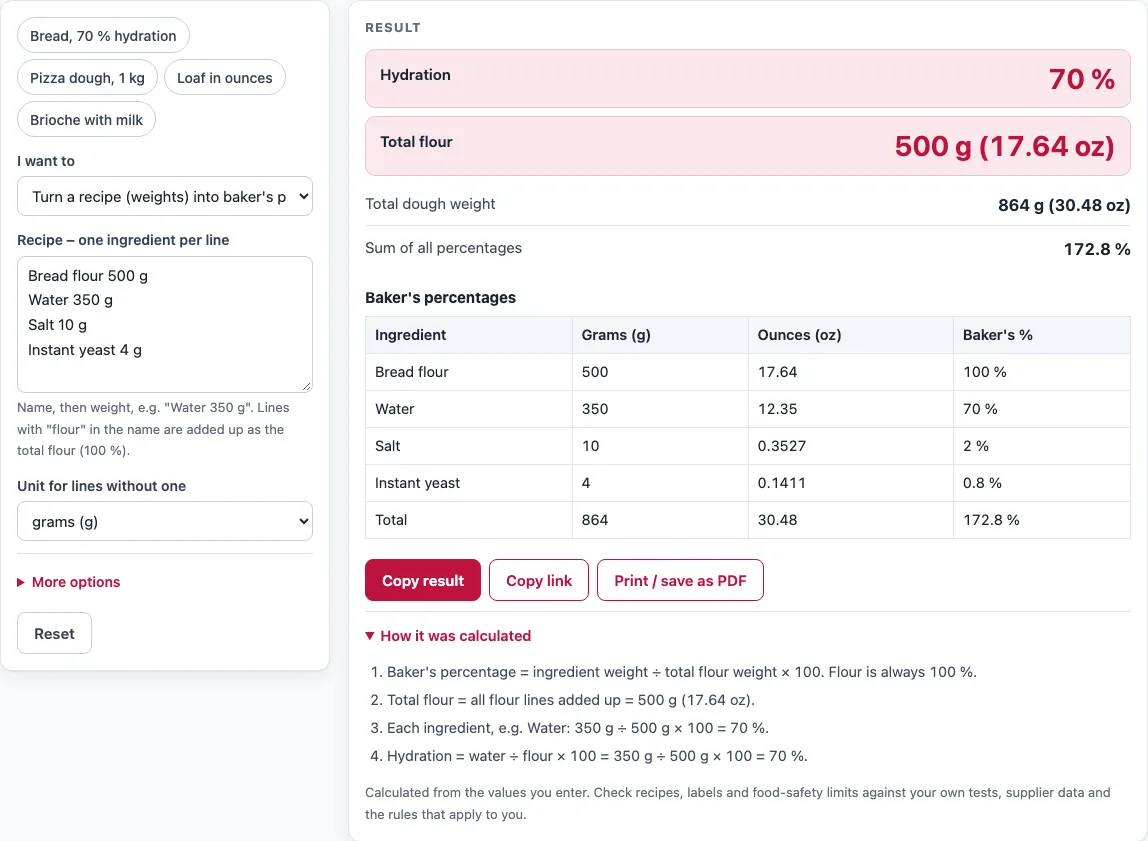
How to use the Baker’s Percentage Calculator
- Under “I want to”, choose either “Turn a recipe (weights) into baker’s percentages” or “Turn baker’s percentages into weights”.
- For a recipe, type one ingredient per line in “Recipe – one ingredient per line”, such as “Water 350 g”. Any line with “flour” in its name is added up as the total flour.
- Pick a unit in “Unit for lines without one” if some lines have no unit written after the weight.
- For a formula, type one ingredient per line in “Formula – one ingredient per line, % of flour”, such as “Water 70 %”. Flour can be left out. If you list several flours, their percentages must add up to 100 %.
- For a formula, under “The amount I know is the”, choose “total dough weight” or “total flour weight”, then enter that amount and its unit in “Amount”.
- If you use milk, juice, or beer, open “More options” and set “Water share of milk, juice, beer… (%)”. The default is 0, so only lines named “water” count toward hydration.
- Read the results: Hydration, Total flour, Total dough weight, and Sum of all percentages. Check “How it was calculated” to see each step with your own numbers.
Copy result copies the result lines. Copy link copies a page address that holds all your inputs, so the same calculation reopens later. Print / save as PDF prints the inputs, results, calculation steps, and the date. Reset restores the default values.
What is baker’s percentage?
Baker’s percentage expresses every ingredient as a percentage of the total flour weight, and flour is always 100 %. Bakers use it because it makes a formula easy to scale: the percentages stay the same whatever the batch size.
For example, take 500 g flour, 350 g water, and 10 g salt. Water is 350 ÷ 500 × 100 = 70 %, and salt is 10 ÷ 500 × 100 = 2 %. The formula is written as flour 100 %, water 70 %, salt 2 %.
How do you calculate dough hydration?
Dough hydration is the water expressed as a percentage of the flour: hydration = water ÷ flour × 100. The 500 g flour and 350 g water example gives 70 % hydration.
Only water counts toward hydration. Milk, juice, and beer contain water too, but the tool only counts them if you set a water share for them. The tool warns when hydration is below 50 %, very low for bread dough, and when it is above 120 %, which is a batter rather than a dough.
How do you turn baker’s percentages into weights?
Start with the amount you know, then work out the flour first. Add up all the percentages, including flour’s 100 %, and divide by 100 to get the total. Flour equals the total dough weight divided by that number, and each ingredient equals the flour weight multiplied by its percentage.
Using the formula flour 100 %, water 70 %, salt 2 %, the percentages add up to 172 %. With a total dough weight of 860 g, the flour is 860 ÷ 1.72 = 500 g. The water is 500 × 0.70 = 350 g, and the salt is 500 × 0.02 = 10 g. If you enter the total flour weight instead, the flour is that amount and each ingredient is calculated from it.
Sources
- King Arthur Baking, What is baker’s math — every ingredient as a percentage of the flour weight
- USDA FoodData Central — water content of whole milk (about 88 %)
- NIST Handbook 44, Appendix C — exact US customary units (1 lb = 453.59237 g, 1 fl oz = 29.5735295625 mL, cup = 8 fl oz)
Worked examples
| Input | Result |
|---|---|
| 4 ingredient lines, 500 g (17.64 oz) flour | hydration 70 %, flour 500 g (17.64 oz), dough 864 g (30.48 oz) |
| 5 ingredient lines, 567 g (20 oz) flour | hydration 70 %, flour 567 g (20 oz), dough 979.5 g (34.55 oz) |
| formula with 1000 g as the total dough weight | hydration 62 %, flour 606.1 g (21.38 oz), dough 1,000 g (35.27 oz) |
| formula with 1 kg as the total flour weight | hydration 72 %, flour 1,000 g (35.27 oz), dough 1,770 g (62.43 oz) |
Calculated by the tool above with these values.
Frequently asked questions
Is the Baker’s Percentage Calculator free, and is anything I type uploaded?
Yes, the tool is free and needs no sign-up. It runs entirely in your browser, and nothing you type is uploaded.
Can I use the results in commercial work such as quotes and bids?
Yes. You can use the numbers, steps, printouts, and labels in any work, including product labels, packaging, menus, recipes, and costing sheets, and no attribution is needed. You are still responsible for accurate inputs, food safety, and compliance with the rules that apply to you.
Why does the tool say no water line was found?
The tool looks for a line named “Water”. If your liquid is milk, juice, or beer, it will not count toward hydration until you set a water share under “More options”.
Which lines does the tool treat as flour?
Any line with “flour” in its name, such as “Bread flour” or “Whole wheat flour”, is added up as the total flour. For a flour with another name, such as rye meal, add “(flour)” at the end of the line.
Does milk count toward dough hydration?
Only if you tell the tool how much of it is water. Whole milk is about 87–88 % water (USDA FoodData Central), so enter 87 under “Water share of milk, juice, beer… (%)” to count it that way.
Related tools
- Sourdough calculator: use it when you want a sourdough-specific calculation for starter and dough.
- Pizza dough calculator: use it when you are working out pizza dough quantities.
- Recipe scaling calculator: use it to resize a recipe to a different batch size.
- Recipe cost calculator: use it to estimate what a recipe costs to make.
- Food cost calculator: use it to work out food costs for your menu or pricing.
- Nutrition label generator: use it to create a nutrition label for a packaged food.
- Supplement facts label generator: use it to create a supplement facts label.
- All calculators: use it to browse every calculator on the site.