Beer Recipe Calculator (OG, ABV, SRM, IBU)
Enter your grains, batch volume, brewhouse efficiency and yeast attenuation to get OG, FG, ABV, colour, IBU and the bitterness ratio, or enter a measured OG to find your efficiency.
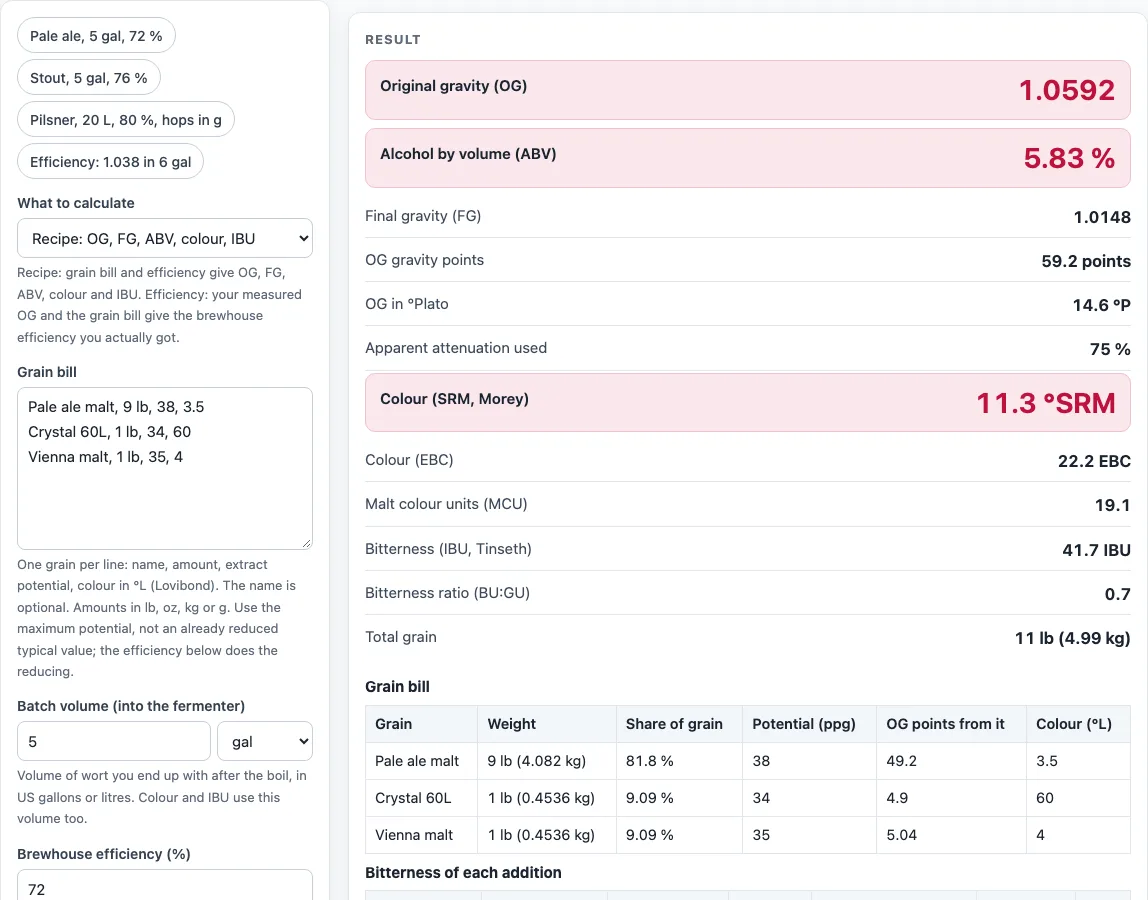
How to use the Beer Recipe Calculator
- Open What to calculate and choose Recipe: OG, FG, ABV, colour, IBU. To find your efficiency from a measured gravity instead, choose Brewhouse efficiency from a measured OG.
- In Grain bill, type one grain per line as name, amount, extract potential and colour in °L. The name is optional. Amounts can be in lb, oz, kg or g.
- Open More options and set Extract potential entered as to ppg or PKL. One ppg equals 8.3454 PKL.
- Enter Batch volume (into the fermenter) in US gallons or litres.
- Set Brewhouse efficiency (%) and Yeast apparent attenuation (%). The defaults are 72 and 75.
- Optional: add lines to Hop additions (optional) as name, amount, alpha acid % and minutes. Leave empty to skip IBU.
- Read OG, FG, ABV, SRM, EBC, MCU, IBU, BU:GU and total grain weight, plus the grain and hop tables.
In efficiency mode, type your Measured original gravity and pick SG or °Plato in Gravity unit. The result shows your efficiency, measured points and potential points.
The example buttons (Pale ale, 5 gal, 72 %, Stout, 5 gal, 76 %, Pilsner, 20 L, 80 %, hops in g and Efficiency: 1.038 in 6 gal) load complete recipes you can change. Copy link keeps your inputs so you can share a recipe. How it was calculated shows each step with your numbers, and Reset clears the page.
How do I calculate OG for a beer recipe?
Original gravity comes from the gravity points your grains add. Each grain adds its extract potential in points per pound per gallon (ppg), and your brewhouse efficiency decides how much of that reaches the fermenter.
Points = sum(lb × ppg) ÷ gallons × efficiency OG = 1 + points ÷ 1000
For the default recipe, the grains total 411 (9 × 38 + 1 × 34 + 1 × 35). Then 411 ÷ 5 × 0.72 = 59.2 points, so OG = 1.0592.
How do I calculate brewhouse efficiency?
Efficiency is the share of the grain’s potential that ends up in your fermenter. Measure the wort gravity, then work back from the grain bill.
Efficiency = measured points × gallons ÷ sum(lb × ppg) × 100
In the efficiency example, 1.038 is 38 points in 6 gallons. The grains total 6.5 × 37 + 0.5 × (28 + 34 + 32 + 25) = 300. So 38 × 6 ÷ 300 × 100 = 76 %.
How do I calculate SRM beer colour from a grain bill?
Colour starts with malt colour units (MCU): each grain’s °L times its pounds, added up and divided by the batch gallons. Morey’s equation converts MCU to SRM.
MCU = sum(°L × lb) ÷ gallons SRM = 1.4922 × MCU^0.6859
For the default recipe, MCU = (3.5 × 9 + 60 + 4) ÷ 5 = 19.1, which gives 11.3 SRM. Real colour can differ from the estimate by 20 % or more.
How do I estimate FG and ABV from OG and attenuation?
Apparent attenuation is the share of the gravity points your yeast ferments.
FG = 1 + (OG − 1) × (1 − attenuation) ABV = (OG − FG) × 131.25
For the default recipe, (1.0592 − 1) × 0.25 = 0.0148, so FG is 1.0148. Then (1.0592 − 1.0148) × 131.25 = 5.83 % ABV.
What is BU:GU?
BU:GU is the bitterness ratio: IBU divided by the wort’s gravity points.
BU:GU = IBU ÷ (OG − 1) × 1000
For the default recipe, 41.7 ÷ 59.2 = 0.70. The tool gives no target range, so judge it by your style.
Sources
- John Palmer, How to Brew: Mash Efficiency — points per pound per gallon, extract efficiency arithmetic and a worked 76 % example
- John Palmer, How to Brew: Table of Typical Malt Yields — maximum extract potential in ppg for common malts and sugars (sucrose 46 ppg)
- Daniel Morey, Approximating SRM Beer Color of Homebrew Based on Recipe Formulation — malt colour units and the power-model colour estimate, with its limits
- Brewer’s Friend, Beer Grain Color Calculator — SRM = 1.4922 × MCU^0.6859 and EBC ≈ 1.97 × SRM
- Glenn Tinseth, Hop Utilization Page (archived) — the IBU method for the optional hops
- BeerSmith, Balancing your Beer with the Bitterness Ratio — BU:GU = IBU ÷ gravity points
Worked examples
| Input | Result |
|---|---|
| 3 grains, 5 gal, 72 % efficiency | OG 1.0592, 5.83 % ABV, 11.3 SRM |
| 4 grains, 5 gal, 76 % efficiency | OG 1.0442, 4.52 % ABV, 29 SRM |
| 2 grains, 20 L, measured OG 1.046 | 59.9 % efficiency |
| 5 grains, 6 gal, measured OG 1.038 | 76 % efficiency |
Calculated by the tool above with these values.
Frequently asked questions
Is the beer recipe calculator free, and is anything I type uploaded?
Yes, the calculator is free and runs in your browser with no sign-up. Nothing you type is uploaded.
How many gravity points does a pound of malt give?
One pound gives its ppg value in points per gallon at 100 % efficiency. In a real batch, multiply by pounds, divide by gallons and then multiply by efficiency. For example, 1 lb at 38 ppg in 5 gallons at 72 % gives about 5.5 points, or an OG rise of 0.0055.
How do I convert SRM to EBC?
Multiply the SRM value by 1.97. The default recipe shows 11.3 SRM and 22.2 EBC on the results, and both figures are printed with the rest of the recipe.
What does the warning above 50 SRM mean?
Morey’s equation was fitted only up to 50 SRM. Above that level, the colour figure is an extrapolation, so treat it as a rough guide.
What brewhouse efficiency should I enter?
Use the efficiency from your own earlier brews on the same system. If you do not know it, switch to “Brewhouse efficiency from a measured OG” after your next brew: enter the grain bill, volume and the OG you measured, and the tool works out the efficiency you actually got.
Related tools
- IBU Calculator: use it to work out bitterness from your hop additions on their own.
- Original Gravity Calculator: use it to check gravity readings from a hydrometer.
- ABV Calculator: use it to find alcohol content from an original and final gravity.
- Mash Water Calculator: use it to plan strike and sparge water volumes before the brew day.
- Yeast Starter Calculator: use it to size a starter for your yeast pitch.
- Priming Sugar Calculator: use it to work out how much sugar to add for carbonation at bottling.
- Brix Calculator: use it to convert refractometer readings to gravity.