Brewing Water Calculator
Enter your water volume, your starting water report and the salts you add to see the ion levels, alkalinity and residual alkalinity.
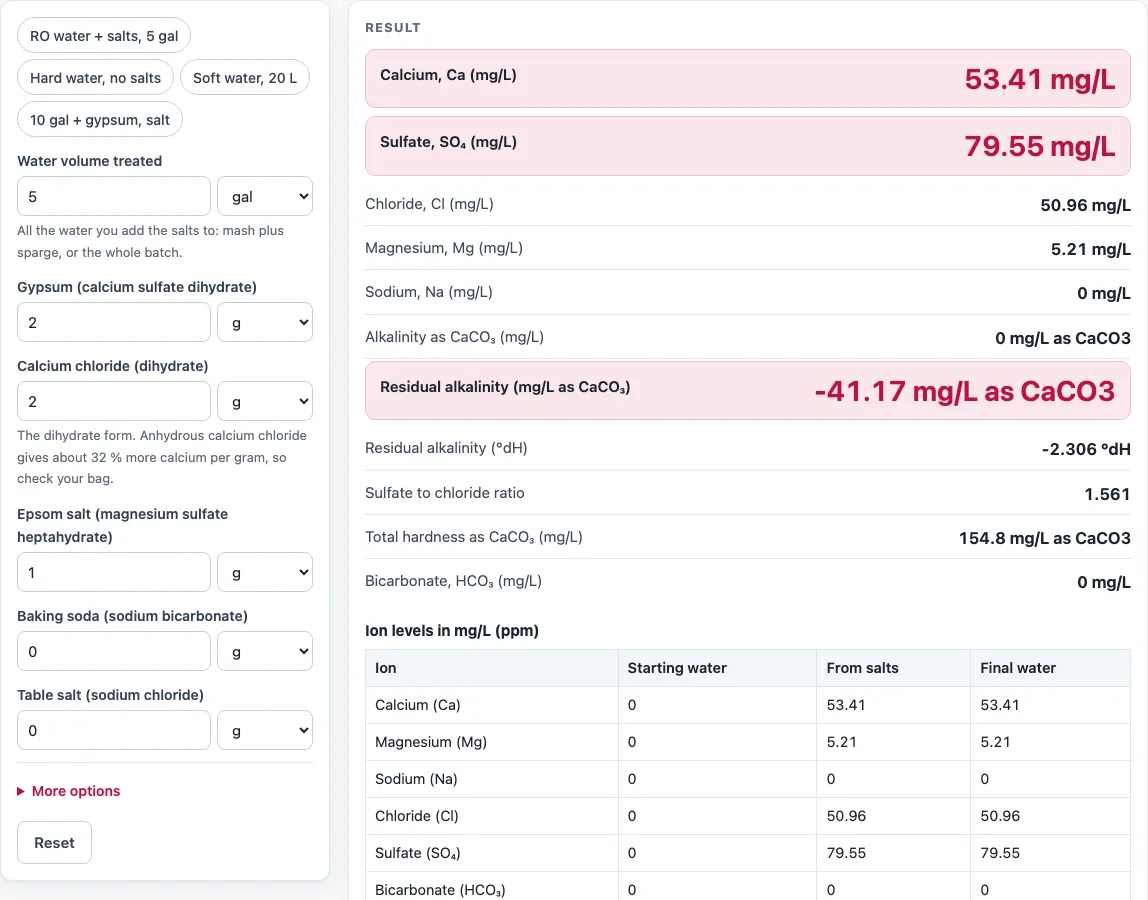
How to use the Brewing Water Calculator
- Enter the Water volume treated in gallons or liters. Use all the water you add the salts to, for example mash plus sparge.
- Enter the amount of each salt you plan to add, in grams or ounces: Gypsum, Calcium chloride (dihydrate), Epsom salt, Baking soda and Table salt. Leave a salt at 0 to skip it.
- If you use tap or well water, open More options and enter your Starting calcium, magnesium, sodium, chloride, sulfate and alkalinity as CaCO₃ from your water report. For distilled or reverse osmosis (RO) water, leave all six at 0.
- Read the final Calcium, Sulfate and Chloride, then the other ions, the Alkalinity and the Residual alkalinity.
- Check the table, which shows the starting level, the amount from the salts and the final level for each ion.
- Open How it was calculated to see each salt’s contribution with your numbers, and change one salt at a time to see its effect on its own.
The example buttons load samples, including the hard water profile from a Brew Your Own article. Reset restores the defaults, Copy link stores your inputs in the page address, Copy result copies the result lines, and Print / save as PDF prints the inputs and steps with the date.
How do you calculate brewing salt additions?
Each salt releases its ions in proportion to its molar mass. Gypsum (CaSO₄·2H₂O, 172.16 g/mol) is 23.28 % calcium and 55.79 % sulfate by weight. Dissolve 2 grams in 5 US gallons (18.93 L) and you add 2,000 mg × 0.2328 ÷ 18.93 L = 24.6 mg/L of calcium and 59.0 mg/L of sulfate. Calcium chloride dihydrate is 27.26 % calcium and 48.2 % chloride, Epsom salt (MgSO₄·7H₂O) is 9.86 % magnesium and 39.0 % sulfate, baking soda is 72.6 % bicarbonate and 27.4 % sodium, and table salt is 39.3 % sodium and 60.7 % chloride. The tool uses IUPAC atomic weights and the hydrated forms homebrewers buy. Anhydrous calcium chloride gives about 32 % more calcium per gram, so check your bag.
What is residual alkalinity?
Residual alkalinity (RA) is the alkalinity left after calcium and magnesium offset part of it. Kolbach’s formula, as Brew Your Own gives it, subtracts the calcium term divided by 3.5 and the magnesium term divided by 7 from the alkalinity, each in mEq/L. In mg/L as CaCO₃ that is RA = alkalinity − 0.714 × Ca − 0.588 × Mg. Brew Your Own’s worked example, 295 mg/L alkalinity as CaCO₃ with 76 mg/L calcium and 18 mg/L magnesium, gives an RA of 12.9 °dH. The tool returns 230.2 mg/L as CaCO₃, which is 12.9 °dH at 0.056 °dH per mg/L. A higher RA pushes the mash pH up and a lower or negative RA pulls it down.
How is alkalinity related to bicarbonate?
Water reports give alkalinity as CaCO₃ or as bicarbonate. Multiply bicarbonate by 0.82 to get alkalinity as CaCO₃, or divide by 0.82 (multiply by 1.22) to go the other way. Adding baking soda raises both: 0.5 g in 20 L adds about 18.2 mg/L of bicarbonate, or 14.9 mg/L of alkalinity as CaCO₃.
What about the sulfate to chloride ratio?
The tool divides final sulfate by final chloride so you can compare recipes. Brewers use the ratio to describe how dry or round a profile tastes, but the right number depends on the beer, so the tool shows the ratio without judging it.
Sources
- Brew Your Own, Ask Mr. Wizard: Utilizing a brewing water calculator — Kolbach residual alkalinity, worked example (295 mg/L alkalinity as CaCO₃, Ca 76, Mg 18 = 12.9 °dH), alkalinity to bicarbonate factor 1.22 (read 2026-10-17)
- IUPAC standard atomic weights — molar masses used for the salt ion shares
- NIST SP 811 — US gallon = 3.785411784 L, ounce = 28.349523125 g
Worked examples
| Input | Result |
|---|---|
| 5 gal, 2 g gypsum, 2 g calcium chloride, 1 g Epsom salt | Ca 53.4, SO₄ 79.5, Cl 51, RA -41.2 mg/L |
| 5 gal, no salts | Ca 76, SO₄ 0, Cl 0, RA 230 mg/L |
| 20 L, 4 g gypsum, 1 g calcium chloride, 0.5 g baking soda | Ca 90.2, SO₄ 132, Cl 39.1, RA -12.4 mg/L |
| 10 gal, 0.25 oz gypsum, 1 g table salt | Ca 43.6, SO₄ 104, Cl 16, RA -31.1 mg/L |
Calculated by the tool above with these values.
Frequently asked questions
Is the calculator free, and is anything I type uploaded?
Yes, it is free. It runs in your browser, needs no sign-up, and nothing you type is uploaded.
Can I use the results in commercial work?
Yes. Results, steps and printouts can be used in any work, including brewing records and recipe cards, and no attribution is needed. They are calculated from the values you enter, so check them against a lab water analysis if you sell your beer.
How many grams of gypsum per gallon do I add?
It depends on the calcium and sulfate you want. One gram of gypsum in 1 US gallon (3.785 L) adds 61.5 mg/L of calcium and 147.4 mg/L of sulfate (1,000 mg × 0.2328 ÷ 3.785 L and 1,000 mg × 0.5579 ÷ 3.785 L). Enter your own gypsum amount and read the calcium and sulfate that results.
Does the calculator tell me which salts to add?
No. It reports what your additions produce. The target profile depends on your style, your grain bill and your mash pH goal, so choose it from a trusted source such as your recipe or a water guide.
Does it predict mash pH?
No. Residual alkalinity is a guide to the direction of the pH change, not a pH prediction. Use a calibrated pH meter on your mash for the real figure.
Why use the dihydrate form of calcium chloride?
It is the form sold to many homebrewers. If your bag says anhydrous or a percentage, the calcium and chloride per gram are higher, so convert the amount or use a different bag.
Related tools
- Mash water calculator: use it to work out the strike water temperature and the mash and sparge volumes whose salts you set here.
- Beer recipe calculator: use it to plan OG, color and bitterness for the beer you are treating water for.
- Yeast starter calculator: use it to size a starter for the same batch.
- Priming sugar calculator: use it to carbonate the finished beer.
- Original gravity calculator: use it to correct a hydrometer reading for temperature.
- ABV calculator: use it to work out alcohol by volume from your readings.
- Mead calculator: use it to plan a mead batch from honey.
- All calculators: browse the full set of tools on this site.