Brine Calculator
Enter the water or meat weight and the salt percentage to get the grams of salt, sugar and curing salt to use.
A brine calculator works out how much salt, sugar or curing salt (sodium nitrite) to weigh for a brine or cure. It has three modes: a salt brine by percentage for a volume or weight of water, an equilibrium brine or cure that sets salt and sugar as a percentage of meat plus water, and a curing salt calculator that turns a target nitrite level in ppm into grams of Cure #1 or Prague Powder #1.
This free tool runs in your browser, needs no sign-up and uploads nothing. Use it for a salt brine for chicken, turkey or pork, a ham or corned beef cure, a bacon brine or dry cure, or a fermentation brine for vegetables. Enter your values, read the results, then check them against a tested recipe before you cure any meat.
How to use the Brine Calculator
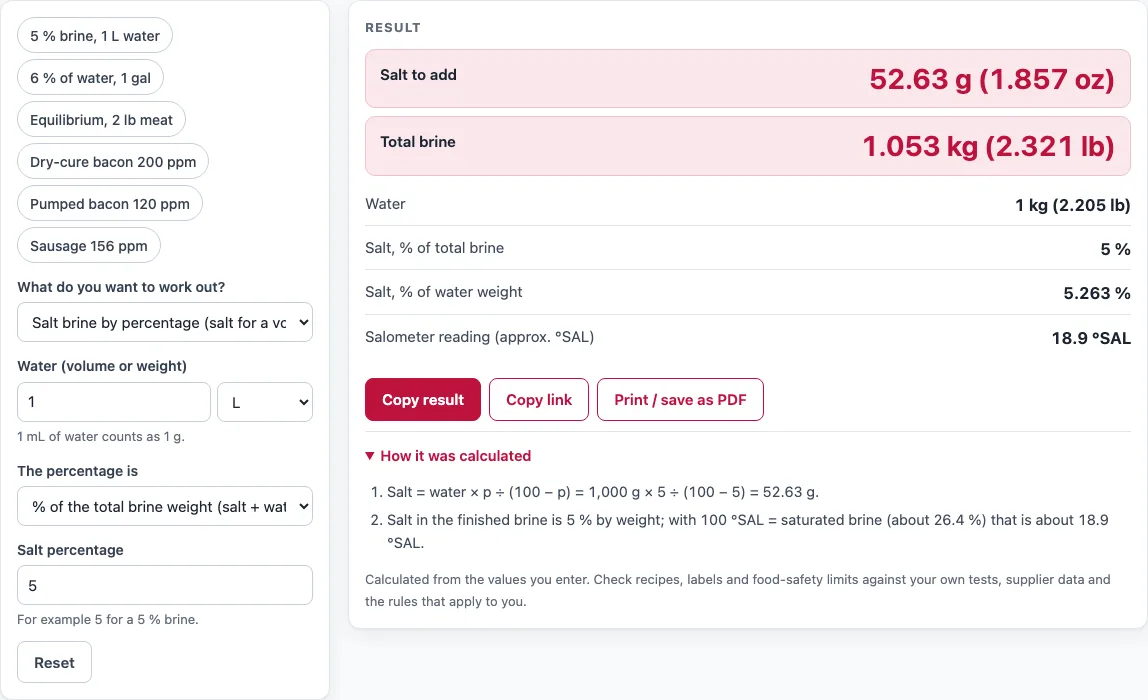
- Open “What do you want to work out?” and choose “Salt brine by percentage (salt for a volume of water)”, “Equilibrium brine / cure (salt and sugar for meat + water)” or “Curing salt (sodium nitrite) for meat”.
- For a salt brine, enter “Water (volume or weight)” and pick a unit (mL, L, fl oz, qt, gal, g, kg, oz or lb). Under “The percentage is” choose “% of the total brine weight (salt + water)” or “% of the water weight”.
- Type “Salt percentage”, such as 5.
- For an equilibrium cure, enter “Meat weight” and the water, then “Salt, % of meat + water” and “Sugar, % of meat + water”. The water must be above zero.
- For curing salt, enter “Meat weight” and the “Target ingoing sodium nitrite (ppm)”. Add water in “Water in a wet cure” for a wet cure, or leave it empty for a dry cure. For Cure #1 or Prague Powder #1, keep “Sodium nitrite in the curing salt (%)” at 6.25.
- Read the results, such as “Salt to add” or “Curing salt to weigh”, and any warnings.
- Open “How it was calculated” to see each step.
Example buttons (“5 % brine, 1 L water”, “Equilibrium, 2 lb meat”, “Dry-cure bacon 200 ppm”, “Pumped bacon 120 ppm”, “Sausage 156 ppm”) load a case. “Reset”, “Copy result”, “Copy link” and “Print / save as PDF” work as named.
How much salt do I need for a brine?
When the percentage is of the total brine weight, salt = water × p ÷ (100 − p), where p is the percentage. For 1,000 g of water at 5 %, that is 1,000 × 5 ÷ 95 = 52.63 g of salt. When the percentage is of the water weight alone, salt = water × p ÷ 100, which gives 50 g for the same water. Recipes differ on which basis they mean, so check before you copy a number. A salt brine for chicken or a fermentation brine for vegetables works the same way; use the percentage your tested recipe gives.
What is an equilibrium brine?
An equilibrium brine weighs salt and sugar as a percentage of the combined weight of meat and water: salt = (meat + water) × salt %. Once the brine has equilibrated, the meat settles at that salt level, which makes the result consistent without exact timing. For 2 lb of meat and 1 qt of water at 2.5 % salt and 1 % sugar, the tool gives the grams of each. This mode does not add curing salt.
Salt water cannot hold more than about 26.4 % salt by weight. The tool also shows an approximate salometer reading, where 100 °SAL is saturated brine; 5 % salt is about 18.9 °SAL. A cure above 6 % salt on meat plus water is very strong, and the tool warns you.
How much curing salt per pound of meat?
Curing salt is weighed from the target nitrite level, not measured by the spoon: curing salt (g) = ppm × weight (g) ÷ (1,000,000 × nitrite fraction). Cure #1 is 6.25 % sodium nitrite, so the fraction is 0.0625. At 156 ppm that is about 1.13 g per pound of meat, or 5.66 g for 5 lb (2,268 g). Water in a wet cure is added to the meat weight, because the nitrite spreads over both.
The presets quote USDA FSIS ingoing limits: 200 ppm for dry-cured bacon, 120 ppm for pumped or immersion-cured bacon and 156 ppm for comminuted products such as sausage. Limits depend on the product, so check the rule that applies to you.
Nitrite is toxic in excess. Cure only with a tested recipe, weigh curing salt on a scale (under 1 g needs one that reads to 0.01 g), and never replace the weighed amount with spoon measures.
Sources
- 9 CFR 424.22(b) (eCFR) — sodium nitrite in bacon: pumped 120 ppm, immersion-cured 120 ppm, dry-cured 200 ppm ingoing
- 9 CFR 424.21(c) (eCFR) — sodium nitrite ¼ oz per 100 lb chopped meat (156 ppm)
- Spices Inc. product specification, Curing Salt (Prague Powder #1) — a manufacturer’s data sheet: salt with 6.25 % sodium nitrite
- Salometer scale: 100 °SAL = 26.4 % salt by weight at 60 °F (Oregon State University Extension brining tables)
Worked examples
| Input | Result |
|---|---|
| 1 L water, 5 % salt | 52.63 g (1.857 oz) salt |
| 1 gal water, 6 % salt | 227.1 g (8.012 oz) salt |
| 2 lb meat, 2.5 % salt | 46.34 g (1.635 oz) salt |
| 5 lb meat at 156 ppm nitrite | 5.66 g (0.2 oz) curing salt |
| 1 kg meat at 120 ppm nitrite | 2.88 g (0.102 oz) curing salt |
Calculated by the tool above with these values.
Frequently asked questions
Is the calculator free, and is anything I type uploaded?
Yes, it is free, runs in your browser and needs no sign-up. Nothing you type is uploaded.
Can I use the results in commercial work?
Yes. Results, steps and printouts can be used in any work, including recipes and product labels, and no attribution is needed. You remain responsible for accurate inputs and for the food-safety rules that apply to you.
Why does the calculator warn me when the ppm is above 200?
Above 200 ppm exceeds the ingoing nitrite limits quoted for bacon and comminuted products. Check the limit for your product before you cure.
Does the equilibrium mode add curing salt?
No. It weighs only salt and sugar, and says so in a warning. Use the curing salt mode for sodium nitrite.
Can I use it for a dry cure or a wet cure?
Yes, in the curing salt mode. Leave “Water in a wet cure” empty for a dry cure, or enter the added water for a wet cure, because the nitrite is spread over the meat and that water.
Can I measure curing salt with a spoon?
No. A spoonful of curing salt varies widely, so weigh it.
Related tools
- Shelf life calculator: use it to estimate how long a finished food will keep.
- Nutrition label generator: use it to build a nutrition facts panel for a packaged food.
- Supplement facts label generator: use it to create a supplement facts panel for a product.
- Food cost calculator: use it to work out the cost of a food item for pricing.
- Recipe cost calculator: use it to total the cost of each ingredient in a recipe.
- Recipe scaling calculator: use it to resize a recipe up or down for a different batch.
- Baker’s percentage calculator: use it to express ingredients as a percentage of flour weight in bread and dough.
- Pasteurization chart and calculator: use it to look up FSIS hold times for cooked meat and poultry.
- Turkey thawing calculator: use it to plan when to start thawing a turkey before you brine it.
- All calculators: use it to browse every tool on this site.