Brix to SG Calculator
Convert Brix to specific gravity or back, correct a refractometer reading taken during fermentation and estimate alcohol.
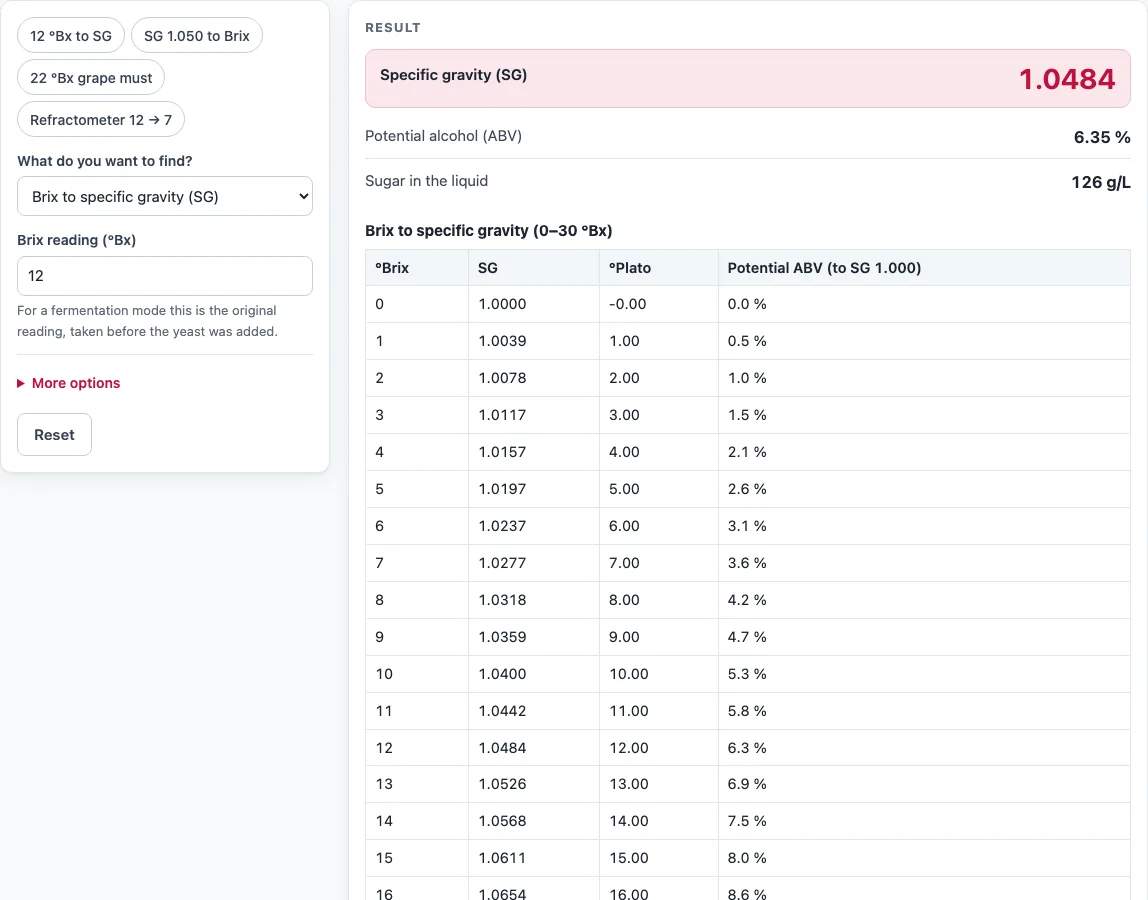
How to use the Brix calculator
- Open “What do you want to find?” and choose one of four options: “Brix to specific gravity (SG)”, “Specific gravity (SG) to Brix”, “Refractometer reading after fermentation starts (corrected FG and ABV)” or “Potential alcohol from Brix (wine, cider, wort)”.
- For any Brix mode, enter the “Brix reading (°Bx)”. In the refractometer mode this is the original reading, taken before the yeast was added.
- For “Specific gravity (SG) to Brix”, enter the “Specific gravity (SG)”, for example 1.050.
- For the refractometer mode, also enter the “Final Brix reading (°Bx)” you read now, with alcohol in the sample.
- In the refractometer mode, open “More options” to find “Wort correction factor (WCF)”. The default is 1.04 and both Brix readings are divided by it, so check it against your own refractometer.
- In the potential alcohol mode, “More options” holds “Final gravity to assume (SG)”. Leave it at 1.000 for a wine that ferments fully dry, or enter a higher value if it keeps some sugar.
- Read the result rows and any warnings. Open “How it was calculated” to see each step with your numbers.
The example buttons load “12 °Bx to SG”, “SG 1.050 to Brix”, “22 °Bx grape must” and “Refractometer 12 → 7”. “Copy result”, “Copy link”, “Print / save as PDF” and “Reset” do what they say.
How do you convert Brix to specific gravity?
Use SG = 1 + B ÷ (258.6 − (B ÷ 258.2 × 227.1)), where B is the Brix reading. Brix is grams of sucrose per 100 g of solution, so the formula turns a percent-sugar figure into the density of the liquid compared with water.
For 12 °Bx, divide 12 by 258.2 to get 0.04648. Multiply by 227.1 to get 10.55 and subtract from 258.6 to get 248.05. Then 12 ÷ 248.05 = 0.04838, so the SG is 1.0484. At 24 °Bx the SG is 1.101.
The same polynomial works in reverse: an SG of 1.050 corresponds to about 12.39 °Bx. The tool treats Brix and degrees Plato as equal, which is close enough for brewing worts, juice and must, so a Plato reading can be used the same way. Sugar in the liquid is estimated as Brix × SG × 10 g/L.
How do you convert Brix to ABV?
The potential alcohol mode subtracts an assumed final gravity from the starting SG and multiplies by 131.25. A starting SG of 1.0484 (12 °Bx) with an assumed FG of 1.000 gives 6.35 % ABV. The preset “22 °Bx grape must” gives SG 1.092 and 12.07 % potential ABV. Wine that keeps some sugar finishes with a higher FG and less alcohol, which is why the assumed value is adjustable. This is a ceiling for what fermentation could produce, not a prediction of what your yeast will do.
How do you correct a refractometer reading for alcohol?
Once fermentation starts, alcohol changes how light bends in the sample, so a refractometer no longer shows sugar alone. The tool divides both Brix readings by the wort correction factor, then applies Sean Terrill’s cubic correction to estimate the corrected final gravity and the ABV. With the default factor of 1.04, readings of 12 °Bx falling to 7 °Bx give a corrected FG of 1.0146 and 4.18 % ABV. With a factor of 1.00 the same readings give 1.0150 and 4.39 %. The corrected FG is an estimate; a hydrometer reading is more direct when you can take one.
Sources
- Brewer’s Friend, Plato to SG conversion — ASBC polynomial for SG ↔ °Plato
- Sean Terrill, Refractometer FG results (2011) — cubic refractometer correction and the 1.04 wort correction factor
- Brewer’s Friend, ABV calculator — ABV = (OG − FG) × 131.25 and the alternate high-gravity formula (after M. L. Hall, Zymurgy 1995)
Worked examples
| Input | Result |
|---|---|
| 12 °Bx | SG 1.0484 |
| SG 1.050 | 12.39 °Bx |
| 22 °Bx | 12.1 % potential ABV |
| 12 → 7 °Bx | FG 1.0150, 4.39 % ABV |
| 24 °Bx | 13.8 % potential ABV |
Calculated by the tool above with these values.
Frequently asked questions
Is the calculator free, and is anything I type uploaded?
Yes, it is free and needs no sign-up. It runs in your browser, and nothing you type is uploaded.
Can I use the results in commercial work?
Yes. Results, steps and printouts can be used in any work, including labels, menus and recipes, and no attribution is needed. You remain responsible for accurate inputs and any rules that apply to your product.
What does the wort correction factor do?
It divides both Brix readings before the refractometer correction is applied. The default is 1.04, but check it against your own refractometer. Changing it changes the corrected FG and ABV.
What final gravity should I assume for wine?
Use 1.000 if the wine ferments fully dry. For a wine that keeps some sugar, enter a higher value. The potential alcohol depends on it.
Why does the calculator warn me about readings above 30 °Bx?
Above 30 °Bx the sugar is probably too much for most yeasts to finish. The result still calculates.
What do the other warnings mean?
If the final Brix is higher than the original, the readings may be swapped. If the corrected FG is below 0.990, which is unusual for this correction, check your readings.
Related tools
- ABV calculator: use it to work out alcohol by volume from your gravity readings.
- Recipe scaling calculator: use it to resize a batch recipe while keeping ingredient amounts in proportion.
- Recipe cost calculator: use it to price a recipe from its ingredients.
- Food cost calculator: use it to measure food cost against menu prices.
- Nutrition label generator: use it to draft a nutrition label for a packaged product.
- Beer recipe calculator: use it to plan OG, colour and bitterness from a grain bill.
- All calculators: use it to browse every calculator on the site.