IBU Calculator (Beer Bitterness from Hops)
Enter your hop additions, boil gravity and batch volume to get the total IBU, the IBU of each addition and the utilization used.
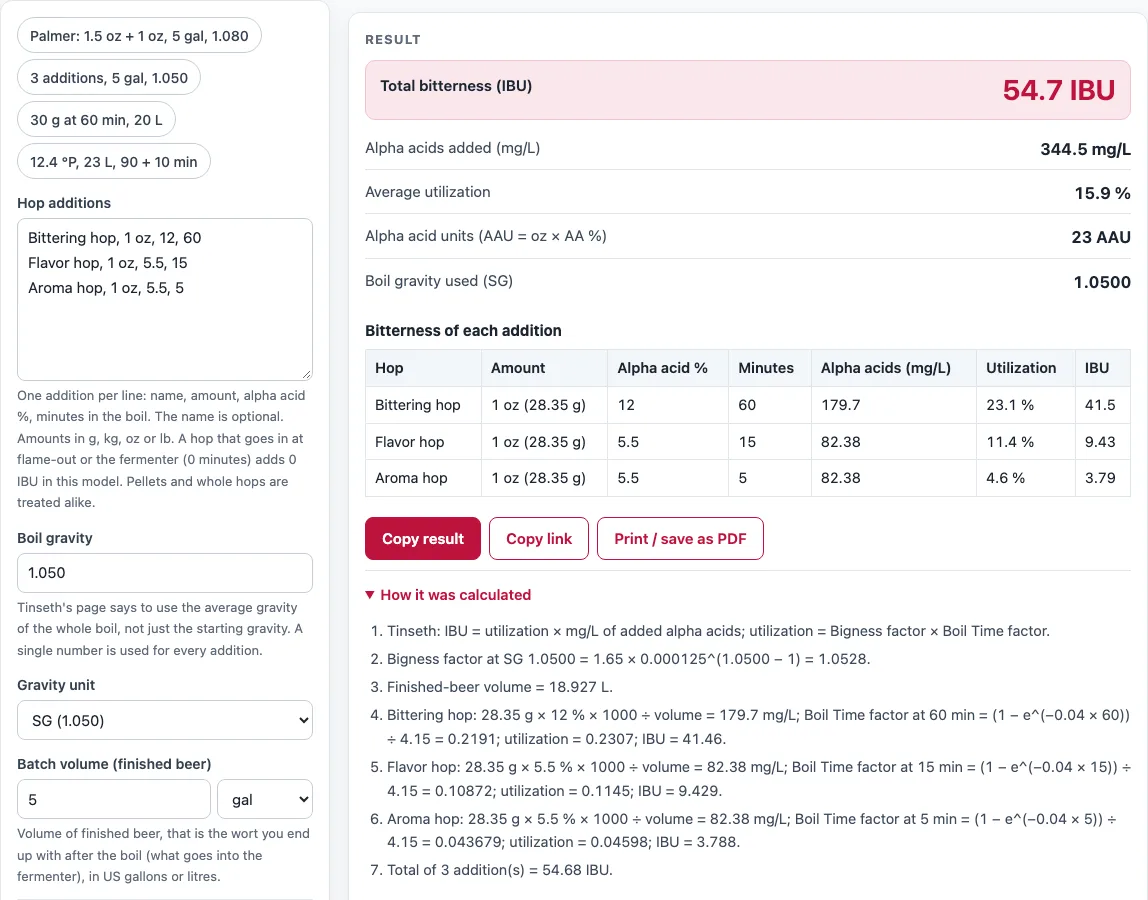
How to use the IBU Calculator
- In the Hop additions box, type one addition per line as name, amount, alpha acid %, minutes in the boil. The name is optional, so
Cascade, 1 oz, 5.5, 15and28 g, 12, 60both work. Amounts accept g, kg, oz or lb, and fractions such as 1/2 oz. - Enter the gravity in Boil gravity, then choose SG or °Plato in Gravity unit. SG must be between 1.000 and 1.200, and °Plato between 0 and 35.
- In Batch volume (finished beer), enter the volume of wort after the boil, the amount that goes into the fermenter. Choose US gallons or litres from the unit menu.
- Read the results: Total bitterness (IBU), Alpha acids added (mg/L), Average utilization, Alpha acid units (AAU = oz × AA %) and Boil gravity used (SG).
- Check the table, which shows each addition’s amount (in your unit, with the g, oz or lb equivalent), its alpha acid %, minutes, mg/L, utilization % and IBU. Read any warning above the results.
- To change the scaling, open More options and set Utilization adjustment (%). It defaults to 100.
Copy link keeps all your inputs, Copy result copies the output, and Print / save as PDF makes a printable copy dated with the day you calculated. How it was calculated shows each step with your numbers. Reset clears the form.
How do I calculate IBU for homebrew beer?
Multiply the utilization of each hop addition by the milligrams per litre of alpha acid it adds, then add the totals. Utilization is the share of the hops’ alpha acid that is isomerized and stays in the beer, and it depends on boil time and wort gravity.
The alpha acid added is found with mg/L = alpha acid fraction × grams of hops × 1000 ÷ litres of finished beer. For example, 30 g of hops at 10% alpha acid in 20 litres gives 0.10 × 30 × 1000 ÷ 20 = 150 mg/L. If that addition has a utilization of 23.07%, it contributes 0.2307 × 150 ≈ 34.6 IBU. The tool does this for every line, then shows average utilization as total IBU divided by total mg/L.
Alpha acid units (AAU) are a separate measure, calculated as oz × AA %. They describe how much alpha acid you added, but they are not bitterness, so they don’t set the IBU total. The same hops give different IBU at different boil times and gravities, which is why the AAU alone cannot predict bitterness.
What is the Tinseth formula?
The Tinseth formula is the method this calculator uses, published by brewer Glenn Tinseth. It calculates utilization as a Bigness factor multiplied by a Boil Time factor.
The Bigness factor is 1.65 × 0.000125^(boil gravity − 1). The Boil Time factor is (1 − e^(−0.04 × minutes)) ÷ 4.15. The Boil Time factor rises with time and levels off, and the 4.15 sets the maximum utilization. Tinseth notes that this constant can be tuned to a brewer’s own system, which is what the Utilization adjustment (%) option does by scaling every utilization value.
The formula reproduces Tinseth’s published table. At 1.050 for 60 minutes, utilization is 0.231. At 1.030 for 30 minutes, it is 0.212. At 1.100 for 90 minutes, it is 0.157. At 1.080 for 15 minutes, it is 0.087.
Tinseth recommends using the average gravity over the whole boil. This tool uses the single gravity you type in for every addition. Boil times above 120 minutes or gravities above 1.130 go beyond Tinseth’s published table, so the tool shows a warning, and the formula is extended to those values.
Sources
- Glenn Tinseth, Hop Utilization Page (archived copy of realbeer.com/hops/research.html) — the Bigness and Boil Time factors, mg/L of added alpha acids and the utilization table
- John Palmer, How to Brew: Hop Bittering Calculations — the same equations with a worked example (1.5 oz + 1 oz in 5 gal = 31 IBU) and the 74.89 unit factor
- Brewer’s Friend, Plato to SG conversion — the ASBC polynomial used when the gravity is entered in °Plato
Worked examples
| Input | Result |
|---|---|
| 2 addition(s), boil gravity 1.080, 5 gal | 31.4 IBU |
| 1 addition(s), boil gravity 1.050, 20 L | 34.6 IBU |
| 3 addition(s), boil gravity 1.050, 5 gal | 54.7 IBU |
| 2 addition(s), boil gravity 12.4 °P, 23 L | 40.1 IBU |
Calculated by the tool above with these values.
Frequently asked questions
How does boil gravity change IBU?
A higher boil gravity lowers utilization, so the same hops give fewer IBU in a stronger wort. This comes from the Bigness factor, 1.65 × 0.000125^(boil gravity − 1), which gets smaller as the gravity rises. Tinseth recommends the average gravity over the whole boil, but the tool uses the one value you enter.
Why do my flame-out or dry hops show 0 IBU?
In Tinseth’s model, an addition with 0 minutes has no time in the boil to isomerize, so it adds 0 IBU. Flame-out, whirlpool and dry hop additions entered at 0 minutes therefore show 0 here. The tool warns you whenever a line has 0 minutes. Those hops still affect aroma and flavour, but this calculator does not count them as bitterness.
Is there an IBU calculator for Excel or a spreadsheet?
This page is a browser tool, and it does not provide an Excel file. You can build your own sheet from the method: mg/L = alpha fraction × grams × 1000 ÷ litres, then multiply by utilization, calculated as the Bigness factor × ((1 − EXP(−0.04 × minutes)) ÷ 4.15). Check your sheet against a known result, such as 30 g at 10% for 60 minutes in 20 litres, which gives 34.6 IBU here.
Do pellet hops give more IBU than whole hops?
This tool treats them the same. There is no pellet-versus-whole-leaf factor, because Tinseth’s published method doesn’t give one. Pellets and whole hops are treated alike, so enter the alpha acid from your hop supplier’s data. Results are estimates, and actual bitterness can differ from the calculated value.
Is the calculator free, and is anything I type uploaded?
Yes, the calculator is free, runs in your browser and needs no sign-up. Nothing you type is uploaded. Your inputs are kept in the page address, so Copy link can save them for later.
Related tools
- Beer Recipe Calculator: use it when you want to plan a full recipe beyond bitterness.
- Original Gravity Calculator: use it to correct a hydrometer reading for temperature or to find the original gravity of your wort.
- ABV Calculator: use it to estimate alcohol content from your starting and finishing gravity.
- Mash Water Calculator: use it to plan the water volumes you need before the boil.
- Priming Sugar Calculator: use it to work out how much sugar to add for carbonation at bottling.