Mash Water Calculator (Strike Temperature, Mash and Sparge Water)
Enter your grain weight, temperatures and water-to-grain ratio to get the strike water temperature and the mash and sparge water volumes.
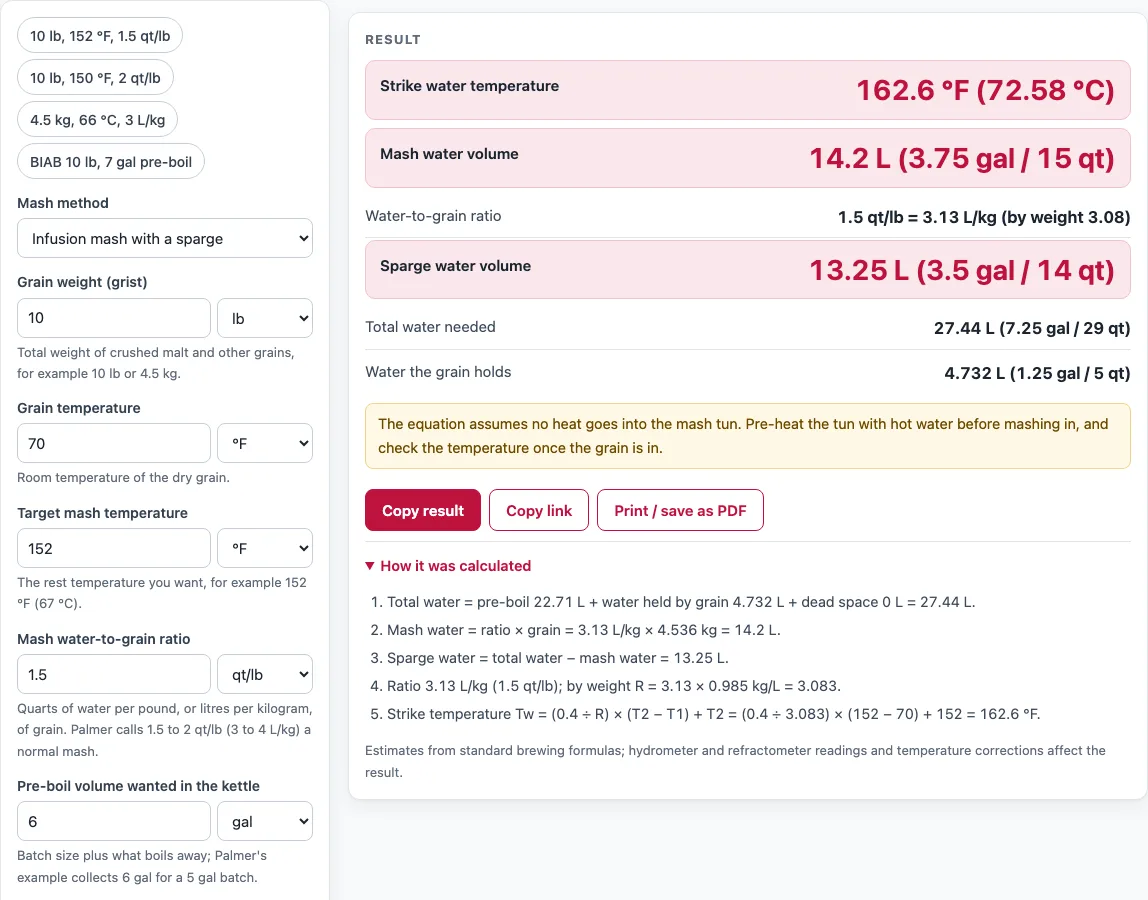
How to use the Mash water calculator
- Choose Mash method: “Infusion mash with a sparge” or “Brew in a bag (full volume, no sparge)”.
- Enter Grain weight (grist) in lb, kg, oz or g. The default is 10 lb.
- Set Grain temperature (default 70 °F) and Target mash temperature (default 152 °F), in °F or °C. The mash temperature must be 100 to 180 °F, and the grain temperature must be between -20 and 120 °F and below the mash temperature.
- Enter Mash water-to-grain ratio in qt/lb or L/kg. The default is 1.5 qt/lb. This field is hidden in brew in a bag mode.
- Enter Pre-boil volume wanted in the kettle in gal, L or qt. The default is 6 gal.
- Open More options if needed. Change Water the grain holds (default 0.5 qt/lb) or Water left in the mash tun or kettle (dead space) (default 0). To plan a mash-out, tick Add a mash-out step and set its two temperatures.
- Read the results: strike water temperature, mash water volume, water-to-grain ratio, sparge water volume, total water needed, and water the grain holds. Check any warning that appears.
Four preset buttons load example recipes so you can see how the fields fit together. Copy link keeps all your inputs, Print / save as PDF prints the page, and Reset clears the form. How it was calculated shows each step.
What temperature should my strike water be?
The strike water is the hot water you add to the grain to reach your target mash temperature. The tool uses Palmer’s equation from How to Brew, chapter 16: Tw = (0.4 / R)(T2 − T1) + T2, where T1 is the grain temperature, T2 is the target mash temperature, and R is the water-to-grain weight ratio. R equals qt/lb × 2.055, or L/kg × 0.985. For 10 lb at 70 °F, 1.5 qt/lb and a 152 °F mash, the strike is 162.6 °F. Because the equation assumes no heat goes into the tun, pre-heat the tun with hot water first. The tool gives the strike water temperature, not a sparge water temperature.
How much water do I need for the mash?
Mash water is the ratio multiplied by the grain weight. For 10 lb at 1.5 qt/lb, that is 15 qt, or 14.2 L. Palmer calls 1.5 to 2 qt/lb (3 to 4 L/kg) a normal mash.
How much sparge water do I need?
Total water is the pre-boil volume plus the water the grain holds plus any dead space. Sparge water is the total minus the mash water. With the 6 gal default, 5 qt held by the grain, and 15 qt in the mash, the total is 29 qt and the sparge is 14 qt (3.5 gal). If the mash water is already more than the total, the sparge becomes 0 and a warning gives the excess in litres.
How do I calculate water for brew in a bag?
In brew in a bag mode, all the water goes into the mash, so the ratio field is hidden and the result shows the ratio that follows. For 10 lb with a 7 gal pre-boil, the full 33 qt (8.25 gal, 31.23 L) goes into the mash. That gives a ratio of 3.3 qt/lb, or 6.78 by weight, with no sparge.
How much water does the grain absorb?
The grain holds water after the mash, and the tool uses 0.5 qt/lb (about 1.04 L/kg) by default, Palmer’s retention figure. For 10 lb, that is 5 qt, or 4.732 L. The tool does not account for wort shrinkage on cooling or boil-off, so enter your pre-boil volume directly.
Sources
- John Palmer, How to Brew, Chapter 16: Methods of Mashing — strike water and mash infusion equations with the 0.4 constant, hot-water density and the worked example used in the tests
- John Palmer, How to Brew, Chapter 17: Lautering — grain retains about 0.5 qt/lb, normal mash ratio 1.5–2 qt/lb, mash-out at 170 °F, 6 gal boil for a 5 gal batch
Worked examples
| Input | Result |
|---|---|
| 10 lb, mash at 152 °F, Infusion mash with a sparge | strike water 162.6 °F (72.58 °C), mash water 14.2 L (3.75 gal / 15 qt) |
| 10 lb, mash at 152 °F, Brew in a bag (full volume, no sparge) | strike water 156.8 °F (69.35 °C), mash water 31.23 L (8.25 gal / 33 qt) |
| 4.5 kg, mash at 66 °C, Infusion mash with a sparge | strike water 162 °F (72.23 °C), mash water 13.5 L (3.566 gal / 14.27 qt) |
Calculated by the tool above with these values.
Frequently asked questions
What mash water to grain ratio should I use?
Palmer calls 1.5 to 2 qt/lb (3 to 4 L/kg) a normal mash. The tool defaults to 1.5 qt/lb, and you can enter the ratio in either unit.
How much hot water for a mash-out?
The mash-out water is calculated with Wm = G(0.4 + R)(T2 − T1)/(Tw − T2), where T1 is the current mash temperature, T2 is the mash-out temperature, and Tw is the mash-out water temperature. The volume is Wm divided by 0.985 kg/L. The defaults are 170 °F for the mash-out and 205 °F for the water. In infusion mode, the sparge after the mash-out is the sparge minus this water.
How do I find my mash-in temperature?
The mash-in temperature is the temperature of the mash after the grain and water are mixed, which you enter as Target mash temperature. The strike water must be hotter than that, and the tool gives the strike figure. Check the real temperature once the grain is in, since heat losses vary.
How do I convert a qt/lb recipe to metric?
Multiply qt/lb by 2.086 to get L/kg, since 1 qt is 0.946 L and 1 lb is 0.4536 kg. For example, 1.5 qt/lb is about 3.1 L/kg. You can also enter the ratio directly in qt/lb or L/kg.
Is the calculator free, and is anything I type uploaded?
Yes, the calculator is free and runs in your browser with no sign-up. Nothing you type is uploaded. Results are estimates.
Related tools
- Beer recipe calculator: use it to plan a full recipe once you know your water volumes.
- IBU calculator: use it to estimate bitterness from your hop additions.
- ABV calculator: use it to estimate alcohol content from your gravity readings.
- Hydrometer temperature correction calculator: use it to correct a gravity reading taken at a non-standard temperature.
- Brewing water calculator: use it to see the mineral content and residual alkalinity of your brewing water.
- All calculators: use it to browse every tool on the site.