Pizza Dough Calculator
Enter how many dough balls, their weight and hydration to get the flour, water, salt and yeast, with or without a preferment.
The pizza dough calculator is a free tool that works out how much flour, water, salt and yeast you need for a set number of pizza dough balls. You enter the number of balls, the weight of each one, and the baker’s percentages you want, and it returns the amounts in grams or ounces. It runs entirely in your browser, needs no sign-up, and does not upload anything you type.
It handles straight dough as well as dough made with a preferment, so you can plan a poolish or a biga before you mix. Example buttons above the form load common setups, such as a Neapolitan batch or a New York batch, so you can see the results before you enter your own numbers. Each result comes with the steps used to reach it, so you can check the math against your own recipe.
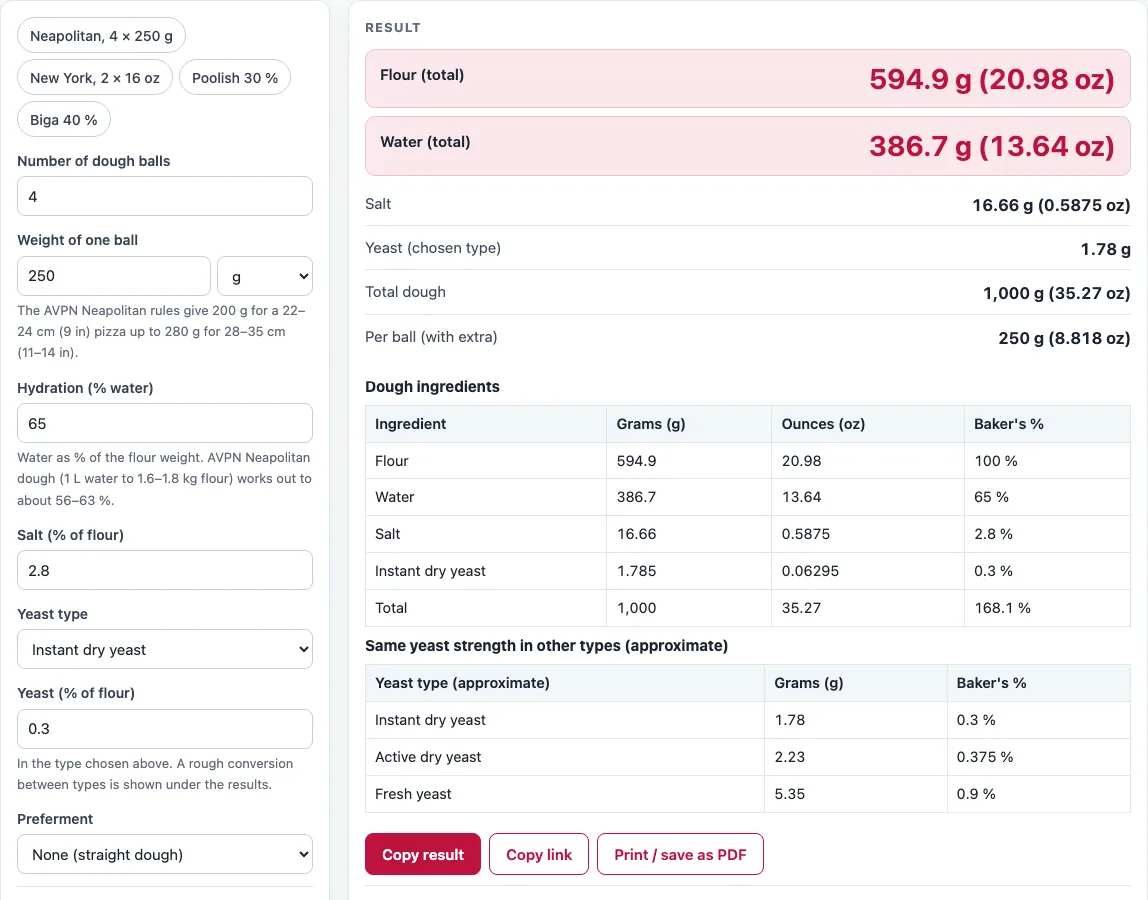
How to use the pizza dough calculator
- Enter the Number of dough balls, then enter the Weight of one ball and choose its unit, g or oz.
- Set Hydration (% water), the water as a percentage of the flour weight. The help text notes that the AVPN Neapolitan rules (1 L of water to 1.6–1.8 kg of flour) work out to about 56–63 %.
- Set Salt (% of flour). The default is 2.8 %.
- Choose a Yeast type: Instant dry yeast, Active dry yeast, or Fresh (compressed) yeast. Then enter Yeast (% of flour) for that type.
- Choose a Preferment: None (straight dough), Poolish (100 % hydration), or Biga (stiff, you set hydration).
- If you chose a preferment, enter Preferment flour (% of total flour), for example 30. If you chose Biga, also enter Biga hydration (%).
- Open More options if you need oil, sugar, extra dough for the bowl, or yeast in the preferment.
- Read the results, which list flour, water, salt, yeast, total dough and the weight per ball, plus the preferment to make first if you chose one. Read any warnings too.
The example buttons above the form fill in Neapolitan, 4 × 250 g, New York, 2 × 16 oz, Poolish 30 % and Biga 40 % setups. Under the result, Copy result copies the result lines, and Copy link copies a page address that holds every input, so the same calculation reopens. Print / save as PDF prints the inputs, results, calculation steps and date. Reset restores the default values.
How much dough do I need for a pizza?
Start with the total dough. The total is the number of balls multiplied by the weight of each ball. The AVPN Neapolitan rules give 200 g for a 22–24 cm (9 in) pizza up to 280 g for 28–35 cm (11–14 in); for other styles, weigh a ball from a recipe you like.
The total is then split into its ingredients. Flour is the base for all the percentages, so the tool divides the total dough by 1 plus the hydration, salt, yeast, oil and sugar, all written as fractions of the flour. The formula is: flour = total dough ÷ (1 + hydration + salt % + yeast % + oil % + sugar %). Water, salt and yeast are then each a percentage of that flour.
Take the default example of 4 balls of 250 g at 65 % hydration. The total is 1,000 g. The percentages add up to 1.681, so the flour is 1,000 ÷ 1.681 = 594.9 g. The water is 65 % of that, or 386.7 g. The salt at 2.8 % is 16.66 g, and the instant dry yeast at 0.3 % is 1.78 g. The result’s calculation steps show each of these lines with your own numbers.
What is a poolish?
A poolish is a preferment made from equal weights of flour and water, so it sits at 100 % hydration. It is mixed first with a small amount of yeast and left to ferment before the final mix. The fermented mix is then folded into the final dough, which many bakers use for more flavor and a better texture.
In the tool, choose Poolish (100 % hydration) under Preferment. Then set Preferment flour (% of total flour) to the share of flour you want in the poolish. The example Poolish 30 % button shows this setup. A biga is a stiffer preferment with less water than the final dough; you set its water yourself with Biga hydration (%).
Sources
- AVPN International Regulations (2024) — Neapolitan dough: 1 L water, 40–60 g salt, 1.6–1.8 kg flour, 200–280 g balls, 1 g dry yeast = 3 g fresh
- King Arthur Baking, How to bake with fresh yeast — fresh yeast × 0.33 = dry yeast
- NIST Handbook 44, Appendix C — exact US customary units (1 lb = 453.59237 g, 1 fl oz = 29.5735295625 mL, cup = 8 fl oz)
Worked examples
| Input | Result |
|---|---|
| 4 balls of 250 g, 65 % hydration | 594.9 g (20.98 oz) flour, 386.7 g (13.64 oz) water, 16.66 g (0.5875 oz) salt, 1.78 g yeast |
| 4 balls of 250 g, 62 % hydration | 606.1 g (21.38 oz) flour, 375.8 g (13.25 oz) water, 16.97 g (0.5986 oz) salt, 1.21 g yeast |
| 2 balls of 16 oz, 62 % hydration | 538.7 g (19 oz) flour, 334 g (11.78 oz) water, 10.77 g (0.38 oz) salt, 2.15 g yeast |
| 4 balls of 250 g, 65 % hydration, Poolish with 30 % of the flour | 594.9 g (20.98 oz) flour, 386.7 g (13.64 oz) water, 16.66 g (0.5875 oz) salt, 1.78 g yeast |
| 4 balls of 250 g, 60 % hydration, Biga with 40 % of the flour | 632.7 g (22.32 oz) flour, 379.6 g (13.39 oz) water, 15.82 g (0.5579 oz) salt, 1.9 g yeast |
Calculated by the tool above with these values.
Frequently asked questions
Is the calculator free, and is anything I type uploaded?
Yes, the calculator is free, needs no sign-up and runs entirely in your browser. Nothing you type is uploaded.
Can I use the results in commercial work such as quotes and bids?
Yes. Results may be used in any work, including commercial work such as product labels, packaging, menus, recipes and costing sheets, and no attribution is needed. Quotes and bids fall under the same rule. You remain responsible for accurate inputs and food safety.
Do I still need to test a recipe before using these numbers?
Yes. The results are calculated only from the values you enter. Check recipes, labels and food-safety limits against your own tests, supplier data and the rules that apply to you.
Why does the calculator show a warning?
Warnings flag values that are outside the usual range. They appear for hydration below 50 % or above 90 %, salt above 3.75 % of the flour (the most the AVPN Neapolitan rules allow), and yeast above 2 % of the flour in instant yeast terms. Other warnings cover a ball under 100 g or over 700 g, extra dough for the bowl above 15 %, and a preferment above 60 % of the flour. Check the unit as well as the value.
Can I convert between yeast types?
The tool shows a rough conversion under the results. Instant dry, active dry and fresh yeast are commonly converted at about 1 : 1.25 : 3 by weight. This is an approximation, so follow the package directions for your brand first.
Related tools
- Baker’s percentage calculator: use it to work out ingredient amounts from baker’s percentages for any bread or dough.
- Sourdough calculator: use it for doughs built around a starter rather than commercial yeast.
- Nutrition label generator: use it to create a nutrition label for a food you sell.
- Supplement facts label generator: use it to create a supplement facts label for a product.
- Food cost calculator: use it to work out what a food item costs you to make.
- Recipe cost calculator: use it to total the cost of every ingredient in a recipe.
- Recipe scaling calculator: use it to resize a recipe up or down for a different batch.
- All calculators: use it to browse every calculator on the site.