Priming Sugar Calculator (Bottle Priming and Keg Carbonation)
Enter the batch size, the warmest temperature and the carbonation you want to get the weight of priming sugar, or switch to a keg to get the regulator pressure.
This priming sugar calculator works out how much sugar to add to beer or cider before bottling so it carbonates in the bottle. It also works as a keg carbonation calculator: it gives the regulator pressure (psi) for force carbonating beer in a keg. The amounts for corn sugar, table sugar, dry malt extract (DME) and honey are shown side by side.
This homebrew carbonation calculator runs in your browser, is free, and needs no sign-up. You enter your batch volume, the highest temperature the beer reached, and the carbonation level you want. The results are estimates based on how much CO2 the beer already holds and how much more your target needs.
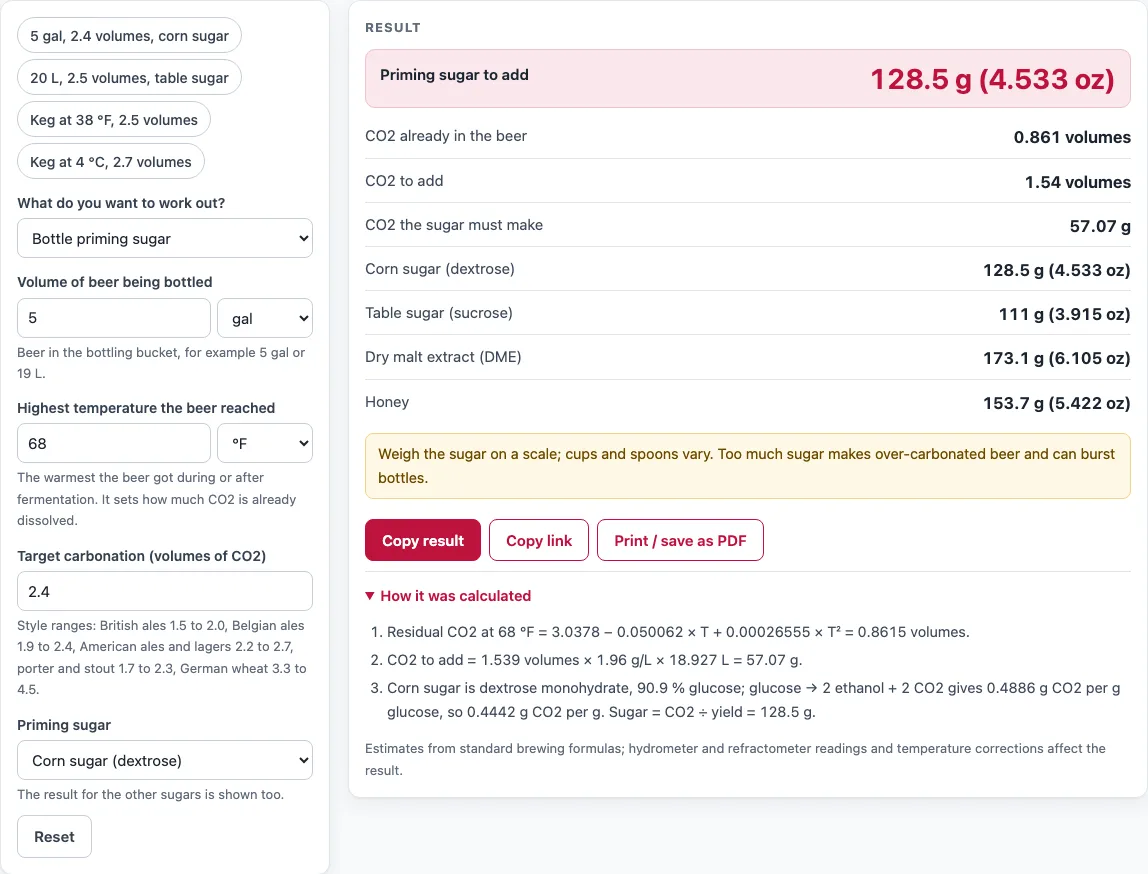
How to use the priming sugar calculator
- Open What do you want to work out? and choose Bottle priming sugar (the default) or Keg force carbonation (PSI).
- For bottles, enter the Volume of beer being bottled and pick your unit: gal, L, qt, mL or fl oz. The default is 5 gal; the volume must be above 0.
- Enter the Highest temperature the beer reached in °F or °C (default 68 °F, allowed 32 to 104 °F).
- Enter the Target carbonation (volumes of CO2). The default is 2.4; it must be above 0 and up to 5.
- Pick your Priming sugar: corn sugar (dextrose), table sugar (sucrose), dry malt extract (DME) or honey.
- Read Priming sugar to add in grams and ounces, with rows for all four sugars below it. Weigh the sugar on a scale.
- For a keg, choose Keg force carbonation (PSI), then set Beer temperature in the keg (28 to 86 °F, default 38 °F) and the Target carbonation (volumes of CO2) (0.5 to 5, default 2.5).
- Read Regulator pressure in psi, bar or kPa, and check CO2 dissolved in the beer in g/L.
Preset buttons such as “5 gal, 2.4 volumes, corn sugar” load an example. Copy result, Copy link, Print / save as PDF and Reset work as labelled. Open How it was calculated to see each step with your numbers.
How much priming sugar do I add for 5 gallons?
For 5 gallons (about 18.9 L) at a highest temperature of 68 °F and a target of 2.4 volumes, add about 128.5 g (4.533 oz) of corn sugar. The tool works this out in three steps: it finds the CO2 already in the beer, finds the CO2 still needed, then converts that gas into sugar.
One volume of CO2 is the amount of gas that would fill the same volume as the beer at 0 °C and 1 atm. That equals 1.96 g of CO2 per litre of beer. Beer already holds some CO2 from fermentation. The tool estimates this with Residual CO2 = 3.0378 − 0.050062 T + 0.00026555 T², where T is in °F. At 68 °F that gives 0.861 volumes.
The CO2 still needed is the target minus the residual: 2.4 − 0.861 = 1.539 volumes. Multiply by 1.96 g/L and by the litres of beer: 1.539 × 1.96 × 18.93 ≈ 57.07 g of CO2.
Sugar makes CO2 when yeast ferments it. Glucose gives 0.4886 g of CO2 per gram, and sucrose gives 0.5143 g per gram. Corn sugar is dextrose monohydrate, 90.9 % glucose, so it gives 0.4442 g of CO2 per gram. Dividing 57.07 g by 0.4442 g/g gives 128.5 g. Because the amounts come from fermentation chemistry, not from a lookup chart, they can differ from popular charts; table sugar in particular comes out about 6 % lower. DME is counted as 67.5 % fermentable and honey as 76 % fermentable, both treated as hexose, which is an assumption.
What PSI for 2.5 volumes at 38 °F?
For beer at 38 °F and 2.5 volumes, set the regulator to about 11.2 psi (0.775 bar, or 77.5 kPa). At that setting the beer holds 4.9 g/L of CO2.
The tool uses a published curve fit for gauge pressure: P = −16.6999 − 0.0101059 T + 0.00116512 T² + 0.173354 T V + 4.24267 V − 0.0684226 V², with T in °F, V in volumes and P in gauge psi at sea level. The fit was checked against a published force carbonation chart, but it is still a fit, so treat the result as a starting point.
The figure is gauge pressure at sea level. At high altitude the gauge reads relative to lower air pressure, so you need a higher setting; the tool gives no altitude correction. The pressure is where the beer ends up in balance, and a still keg takes about a week or more to get there.
Sources
- Brewer’s Friend, Beer Priming Sugar Calculator — residual CO2 equation from the highest temperature, and the carbonation range by beer style
- Brewer’s Friend, Keg Carbonation Calculator — the pressure fit for temperature and volumes of CO2
- Brewer’s Friend, Force Carbonation Chart — chart values used to check the pressure fit
- John Palmer, How to Brew, Chapter 11 — priming sugars table: percent solids and fermentability of corn sugar, cane sugar, honey and dry malt extract
- NIST Chemistry WebBook — molar masses of glucose, sucrose, carbon dioxide and water used in the fermentation arithmetic
- NIST CODATA, molar volume of an ideal gas at 273.15 K and 101.325 kPa — 22.414 L/mol, which gives 1.96 g of CO2 per litre per volume
Worked examples
| Input | Result |
|---|---|
| 5 gal of beer, 2.4 volumes, highest temperature 68 °F | 128.5 g (4.533 oz) of Corn sugar (dextrose) |
| 20 L of beer, 2.5 volumes, highest temperature 20 °C | 124.9 g (4.405 oz) of Table sugar (sucrose) |
| Keg at 38 °F, 2.5 volumes | 11.2 psi (0.775 bar) |
| Keg at 4 °C, 2.7 volumes | 14 psi (0.965 bar) |
Calculated by the tool above with these values.
Frequently asked questions
How much corn sugar vs table sugar vs DME do I need?
Corn sugar is the reference. For the same amount of CO2, table sugar needs about 0.86 times the weight of corn sugar, honey about 1.20 times, and DME about 1.35 times. Choose the sugar you have on hand, then weigh it on a scale.
Does beer have CO2 before priming?
Yes. Fermented beer already holds CO2, and the amount depends on temperature. At 68 °F (20 °C) it holds about 0.861 volumes, so the tool subtracts that from your target. If your target is at or below the amount already in the beer, the tool shows 0 g and a warning that no sugar is needed.
What carbonation level does my beer style need?
These are typical style ranges, from published brewing sources: British ales 1.5 to 2.0 volumes, Belgian ales 1.9 to 2.4, American ales and lagers 2.2 to 2.7, porter and stout 1.7 to 2.3, and German wheat 3.3 to 4.5. If you enter more than 4.5 volumes, the tool warns that the level is higher than any listed style and needs bottles made for high carbonation.
How many grams of sugar per bottle or per litre?
The tool gives the total for your whole batch. To get grams per litre, divide the sugar weight by the litres of beer. For example, 128.5 g of corn sugar in 18.9 L is about 6.8 g per litre. To get grams per bottle, divide the total by the number of bottles you fill.
How do I prime cider?
Enter the cider volume, the highest temperature the cider reached, and your target volumes. The arithmetic is the same as for beer. The tool has no cider-specific numbers, so choose a target that suits the style of cider you make.
Is the calculator free, and is anything I type uploaded?
Yes, the calculator is free, runs in your browser, and needs no sign-up. Nothing you type is uploaded. The results are estimates, so check them against your own recipe and equipment.
Related tools
- ABV calculator: use it to estimate the alcohol content of your beer from its gravity readings.
- Hydrometer temperature correction calculator: use it to correct a hydrometer reading taken at a temperature other than the calibration temperature.
- IBU calculator: use it to estimate the bitterness of a recipe from its hops.
- Beer recipe calculator: use it to plan the full set of ingredients for a batch.
- Brix to SG calculator: use it to convert a Brix reading to specific gravity.
- Yeast starter calculator: use it to size a yeast starter before you brew.
- Mash water calculator: use it to work out how much water to heat for your mash.
- All calculators: use it to browse every calculator on this site.