Recipe Cost Calculator
Paste your ingredients with amounts and pack prices to get the recipe cost, cost per serving and a suggested price.
This recipe cost calculator works out what a batch of a recipe costs, then the cost per serving and a suggested selling price. It is free, runs entirely in your browser, and needs no sign-up. It suits home bakers, cookie sellers, and bakery or restaurant kitchens that want a costing estimate before they set a menu price.
You list each ingredient with the amount you use and the price you pay for the pack, then enter how many servings or pieces the batch makes. The tool converts units for you, as long as both amounts are the same kind: weight with weight, volume with volume, or count with count. Every result comes from the values you type, and the steps underneath show how each figure was reached.
How to use the Recipe cost calculator
- Start with an example if you want to see how it works. Use one of the example buttons above the form: “Cookies, mixed units”, “Bread, metric” or “Pancakes, US units”.
- In the Ingredients: name, amount used, price per pack box, type one ingredient per line, for example
Flour, 500 g, 2.49 per 1 kg. Prices use a decimal point. - In Servings or pieces from this batch, enter how many servings or pieces the batch makes.
- Choose an option under Suggested price: a target food cost, a markup on cost, or none.
- If you chose a target food cost, enter it in Target food cost (%). If you chose a markup, enter it in Markup on cost (%).
- Open More options and enter any packaging or other cost for the batch in Packaging or other cost per batch. Leave it at zero if you have none.
- Read the result rows and any warnings, then check the How it was calculated section against your own numbers.
Under the result, Copy result copies the result lines, and Copy link copies a page address that holds all your inputs, so the same calculation reopens later. Print / save as PDF prints the inputs, results, steps and date. Reset restores the default values.
How do I cost a recipe?
To cost a recipe, work out what each ingredient used in one batch costs, then add those amounts together along with any packaging or other cost for that batch. Each ingredient uses the same line formula: amount used ÷ pack size × pack price, with both amounts converted to the same base unit first.
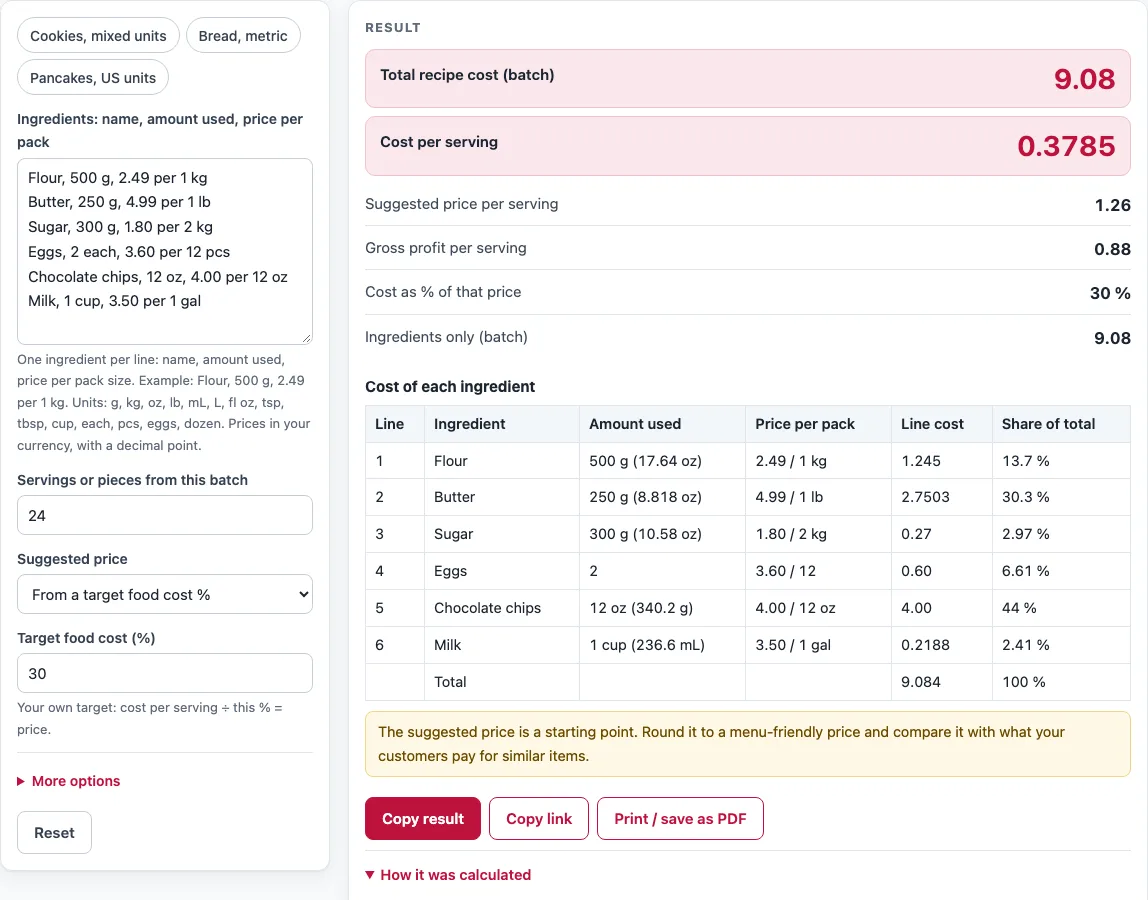
For example, 500 g of flour bought as a 1 kg bag at 2.49 costs 500 ÷ 1000 × 2.49 = 1.245. Butter at 250 g from a 1 lb pack priced at 4.99 costs 2.7503, because 1 lb is about 453.6 g. The default recipe has six ingredient lines, and their total is 9.08. With no packaging cost, the batch cost is 9.08.
Weight, volume and count cannot be converted into each other without a density or piece weight. That is why the tool asks for matching kinds. If your milk is listed in cups but the pack is in gallons, both are volumes, so they convert. If eggs are listed in pieces but the pack is in grams, you will need to restate one of them.
How do I calculate cost per serving?
Divide the total batch cost by the number of servings or pieces the batch makes. Cost per serving = total recipe cost ÷ servings. In the default example, 9.08 ÷ 24 = 0.3785 per serving.
To turn that cost into a price, the tool offers two routes. With a target food cost, the price is cost per serving ÷ your target percentage. At a 30 % target, 0.3785 ÷ 0.30 gives a suggested price of 1.26. With a markup, the price is cost plus the markup applied to cost, so a 200 % markup makes the price three times the cost.
Two more rows help you compare. Gross profit per serving is the suggested price minus the cost per serving. Cost as % of that price shows how much of the price the ingredients take up. If the servings figure is not a whole number, the tool still divides the batch cost by it. The suggested price is a starting point, so round it to a price that suits your menu and compare it with what customers already pay for similar items.
Sources
- NIST Handbook 44, Appendix C — exact US customary units (1 lb = 453.59237 g, 1 fl oz = 29.5735295625 mL, cup = 8 fl oz)
Worked examples
| Input | Result |
|---|---|
| 6 ingredients, 24 servings | batch 9.08, 0.3785 per serving, suggested price 1.26 |
| 4 ingredients, 2 servings | batch 1.68, 0.838 per serving, suggested price 3.35 |
| 5 ingredients, 4 servings | batch 4.78, 1.1945 per serving, suggested price 3.98 |
| 5 ingredients, 1 servings | batch 4.11, 4.1088 per serving, suggested price 12.84 |
| 3 ingredients, 30 servings | batch 11.04, 0.368 per serving |
Calculated by the tool above with these values.
Frequently asked questions
How do I cost a recipe?
Add up the cost of each ingredient used in one batch, using amount used ÷ pack size × pack price for each line, then add any packaging or other cost for that batch. The tool does this for you once you enter each ingredient on its own line.
How do I calculate cost per serving?
Divide the total batch cost by the number of servings or pieces the batch makes. For example, a batch costing 9.08 that makes 24 servings works out to 0.3785 per serving.
Is the calculator free, and is anything I type uploaded?
Yes. The tool is free, runs entirely in your browser, and needs no sign-up. Nothing you type is uploaded.
Can I use the results in commercial work such as quotes and bids?
Yes. Numbers, steps, printouts and labels may be used in any work, including commercial work such as product labels, packaging, menus, recipes and costing sheets, and no attribution is needed. You are still responsible for accurate inputs, food safety and compliance with the rules that apply to you, so check results against your own tests and supplier data.
Why does the tool ask for matching units?
Weight, volume and count cannot be converted into each other without a density or a piece weight, so the tool only converts within the same kind. If an ingredient is priced in a different kind of unit from how you use it, restate one of them in the same kind before you enter it.
Why am I seeing a warning that packaging is larger than all the ingredients?
The packaging or other cost is larger than all the ingredients added together. This often means the figure was meant per item rather than per batch. Check the amount you entered in Packaging or other cost per batch.
Related tools
- Food cost calculator: use it to look at food cost across a menu rather than a single recipe.
- Recipe scaling calculator: use it to change a recipe’s batch size before you cost it.
- Nutrition label generator: use it when you need a nutrition panel for a packaged food.
- Supplement facts label generator: use it when you are labeling a supplement product.
- Baker’s percentage calculator: use it to express dough or bake formulas as percentages of flour weight.
- Sourdough calculator: use it to work out the quantities for a sourdough bake.
- Pizza dough calculator: use it to size dough quantities for pizza.
- All calculators: use it to browse every calculator on the site.