Shelf Life Calculator
Enter the shelf life found at a test temperature and the Q10 or activation energy to predict shelf life at your storage temperature.
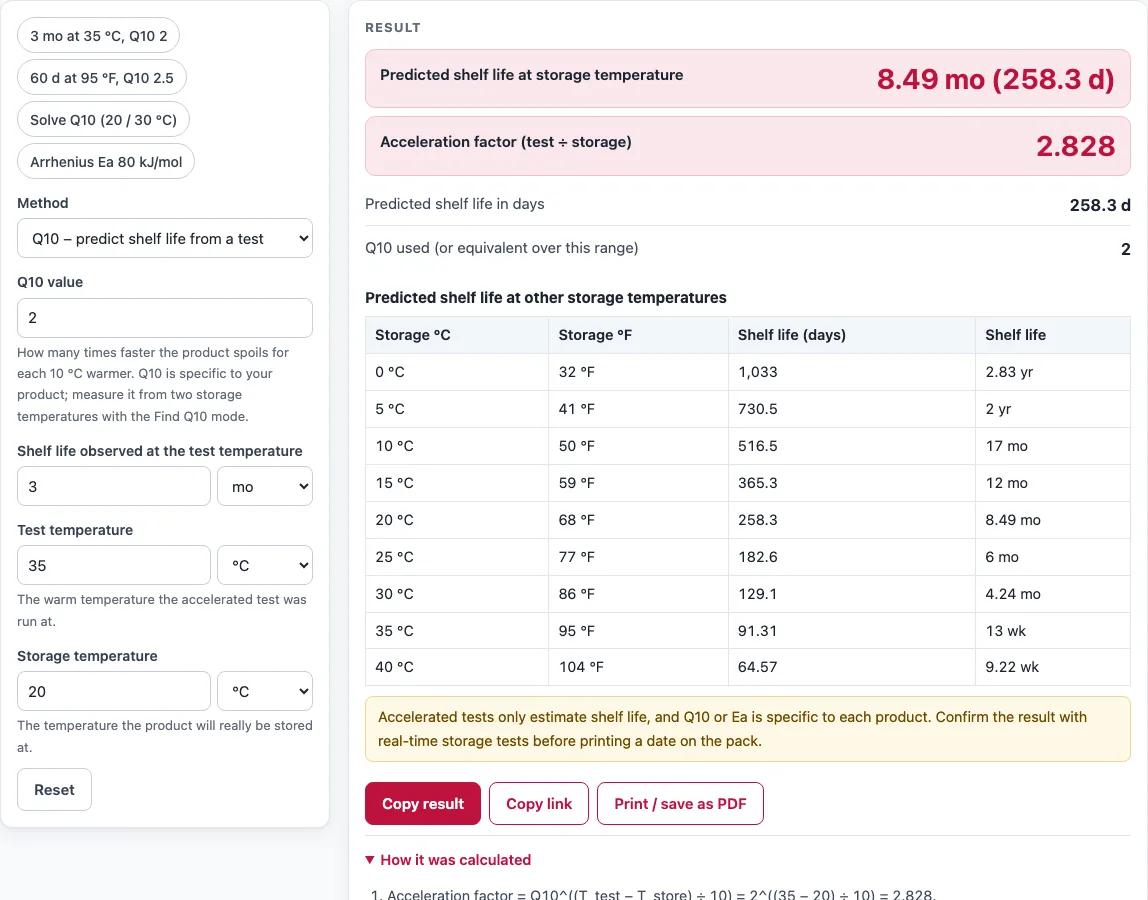
How to use the Shelf life calculator
- Choose a Method from the drop-down: “Q10 – predict shelf life from a test”, “Find Q10 from two observed shelf lives”, or “Arrhenius – from activation energy (Ea)”.
- If you predict from a Q10 value, enter it in Q10 value. If you use activation energy, enter Activation energy (Ea) in kJ/mol, measured for the spoilage reaction you are tracking.
- Enter Shelf life observed at the test temperature and pick its unit (d, wk or mo).
- Enter the Test temperature and pick °C or °F. This is the warm temperature your accelerated test ran at.
- If you are solving for Q10, also enter Shelf life observed at the second temperature and Second test temperature.
- Enter the Storage temperature, the temperature the product will really be stored at.
- Read “Predicted shelf life at storage temperature”, the acceleration factor, the shelf life in days and the Q10 used. A table lists other storage temperatures from 0 to 40 °C.
- Open How it was calculated to check each step.
The example buttons (“3 mo at 35 °C, Q10 2”, “60 d at 95 °F, Q10 2.5”, “Solve Q10 (20 / 30 °C)”, “Arrhenius Ea 80 kJ/mol”) fill in a ready-made calculation. Reset, Copy result, Copy link and Print / save as PDF work as named.
What is the shelf life formula?
The shelf life formula scales a shelf life measured at a warm test temperature down to the cooler temperature where the product will be stored. The Q10 version is: shelf life at storage = shelf life at test × Q10^((T_test − T_storage) ÷ 10). The part Q10^((T_test − T_storage) ÷ 10) is the acceleration factor, which tells you how many times faster the product spoils at the test temperature.
Q10 is the factor by which a reaction rate rises for every 10 °C increase. For example, 30 days at 45 °C with Q10 = 2 gives 30 × 2^2.5 ≈ 170 days at 20 °C. There is no single right value: Q10 depends on the product and on which quality change ends its shelf life, so measure it at two storage temperatures if you can. A Q10 below 1 would mean the product lasts longer when warmer, which is unusual for spoilage, so check your readings if you see that.
The Arrhenius method uses activation energy instead: acceleration factor = exp(Ea ÷ R × (1 ÷ T_storage − 1 ÷ T_test)), with temperatures in kelvin and R = 8.314 J/(mol·K). There is no general Ea for a whole food, so use a value measured for your own reaction.
How does accelerated shelf life testing work?
Accelerated shelf life testing stores samples at higher temperatures, where spoilage happens faster, and then uses that speed-up to estimate shelf life at normal storage temperatures. You record how long the samples last at each test temperature, then convert that time with the formula above. If you have observed shelf lives at two temperatures, the “Find Q10 from two observed shelf lives” method works out the Q10 for you first.
The default values show the steps. A product that lasts 3 months (91.31 days) at 35 °C, stored at 20 °C, has an acceleration factor of 2^((35 − 20) ÷ 10) = 2.828 with Q10 = 2. Its predicted shelf life is 91.31 × 2.828 = 258.3 days, or about 8.5 months.
The further apart the test and storage temperatures are, the less reliable the estimate. The tool warns when they are more than 30 °C apart, because the reaction may change over a long extrapolation, for example above a melting point. Keep your test temperatures close to the storage range where you can, and treat the result as a prediction until real-time storage tests confirm it.
Sources
- T. P. Labuza, Shelf-Life Dating of Foods (Food & Nutrition Press, 1982) — the Q10 method; see also IFT, Ted Labuza on reaction rates
- NIST CODATA, molar gas constant — R = 8.314462618 J/(mol·K) for the Arrhenius equation
Worked examples
| Input | Result |
|---|---|
| 3 mo at 35 °C, stored at 20 °C | 8.49 mo (258.3 d), AF 2.83 |
| 60 d at 95 °F, stored at 68 °F | 7.79 mo (237.2 d), AF 3.95 |
| 60 d at 20 °C, stored at 5 °C | 5.58 mo (169.7 d), AF 2.83 |
| 2 mo at 40 °C, stored at 25 °C | 9.38 mo (285.6 d), AF 4.69 |
Calculated by the tool above with these values.
Frequently asked questions
Is the calculator free, and is anything I type uploaded?
Yes, the tool is free, runs entirely in your browser, and needs no sign-up. Nothing you type is uploaded.
Can I use the results in commercial work?
Yes. Results, numbers, steps and printouts may be used in any work, including commercial work such as product labels, packaging, menus, recipes and costing sheets, and no attribution is needed. You remain responsible for accurate inputs, food safety and compliance with the rules that apply to you.
Can I print the calculated date on my product pack?
Not from the calculation alone. Accelerated results are estimates, so confirm them with real-time storage tests before printing a date on a pack. Check recipes, labels and food-safety limits against your own tests and supplier data.
What do the Q10 warnings mean?
A Q10 below 1 means the product lasts longer when warmer, which is unusual for spoilage, so check your readings. A Q10 above 10 is extreme, so check both shelf lives and both temperatures before you rely on the result.
Can I use the shelf life calculator for pharmaceutical products or medicines?
The calculator applies the same temperature rule to any product, but Q10 or Ea must come from your own product and its spoilage reaction. Stability requirements for medicines are set by the rules that apply to you, so check them and your real-time stability data before relying on an estimate.
Related tools
- Food cost calculator: use it to work out what a product costs to make once you know how long it can be sold.
- Recipe cost calculator: use it to total ingredient costs for a costing sheet or quote.
- Recipe scaling calculator: use it to resize a batch before you run a shelf life test on the scaled product.
- Nutrition label generator: use it to prepare the nutrition panel for a packaged food.
- Pasteurization chart and calculator: use it to look up FSIS hold times or work out pasteurization units and F-values.
- All calculators: browse the full set of tools on this site.