Sourdough Calculator
Set the dough size, hydration and starter percentage to get flour, water and salt, counting the water and flour in the starter.
A sourdough calculator works out how much flour, water, salt and starter a sourdough dough needs, based on the weights and percentages you choose. This one also works out how to feed a starter, and it checks the true hydration of a dough you have already made. It is free, runs entirely in your browser, and needs no sign-up.
Every amount is shown as a percentage of total flour, so the tool also works as a sourdough bakers percentages calculator and a sourdough bread ratio calculator. Enter a total dough weight or total flour weight, set hydration, starter and salt, and the results appear in grams and ounces. Each result comes with the steps behind it, so you can see how the figures were reached before you start mixing.
How to use the Sourdough calculator
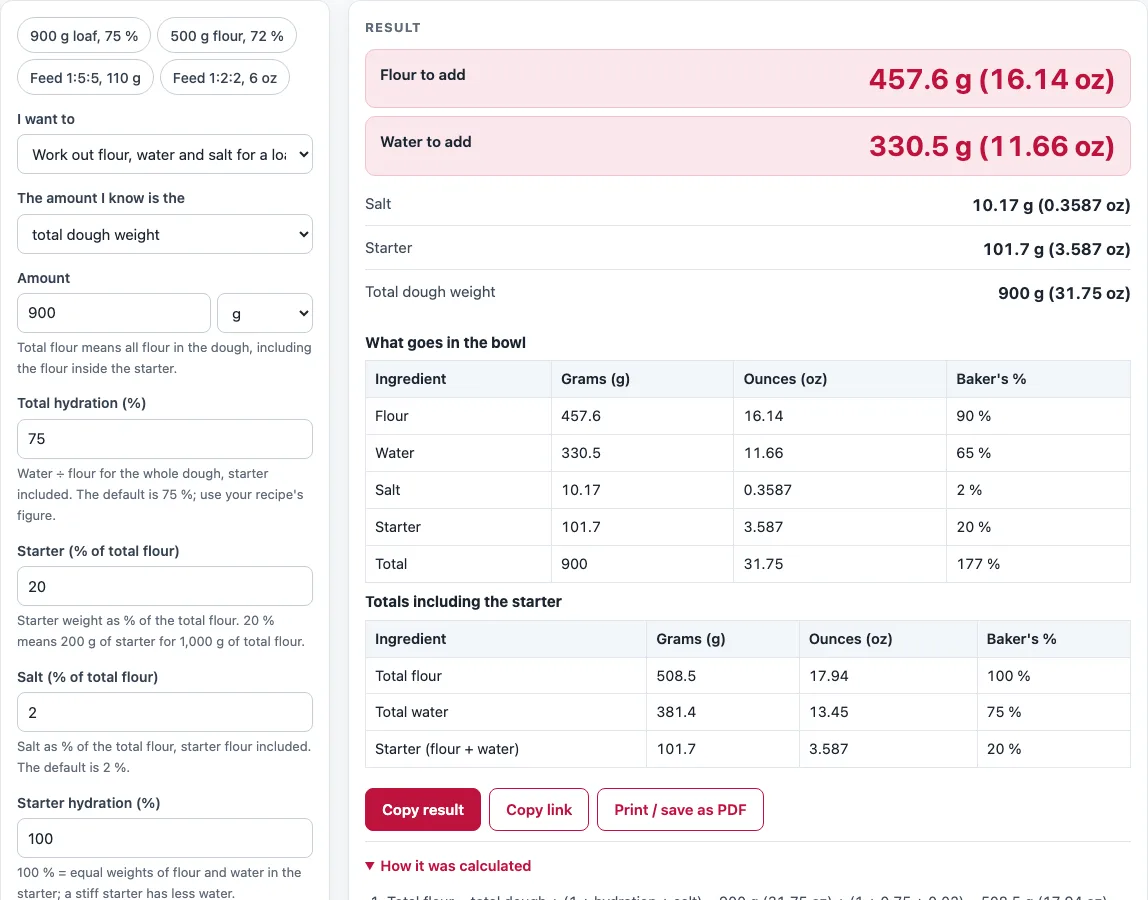
- Open “I want to” and choose one option: “Work out flour, water and salt for a loaf”, “Feed my starter (ratio such as 1:5:5)”, or “Check the true hydration of my dough”.
- For a loaf, set “The amount I know is the” to total dough weight or total flour weight. Enter the figure in “Amount” and pick g, oz, lb or kg. If your starter is not 100 % hydration, also set “Starter hydration (%)”.
- Enter “Total hydration (%)”, the water as a share of all the flour, starter included. The default is 75 %.
- Enter “Starter (% of total flour)”. The default is 20 %.
- Enter “Salt (% of total flour)”. The default is 2 %.
- To feed a starter, enter “Feeding ratio (starter : flour : water)”, such as 1:2:2, and “Total fed starter wanted”.
- To check a dough, enter “Flour you add”, “Water you add” and “Starter you add”, along with “Starter hydration (%)”.
- Read the results and “How it was calculated”. Check any warning before you use the figures.
The example buttons above the form (“900 g loaf, 75 %”, “500 g flour, 72 %”, “Feed 1:5:5, 110 g” and “Feed 1:2:2, 6 oz”) fill in sample values. “Copy result” copies the result lines. “Copy link” copies a page address that holds every input, so the same calculation reopens. “Print / save as PDF” prints the inputs, results, steps and date. “Reset” restores the default values.
How do I calculate sourdough hydration?
Hydration is the weight of water divided by the weight of flour, shown as a percentage. In a sourdough dough, the flour and water inside the starter count too, so the tool works from the whole dough. Total flour equals total dough weight divided by (1 + hydration + salt), with hydration and salt written as decimals of flour weight.
Using the default values: 900 g of dough at 75 % hydration with 2 % salt gives 900 ÷ (1 + 0.75 + 0.02) = 508.5 g of total flour. The starter at 20 % of that flour weighs 101.7 g. Once the starter’s own flour and water are taken away from the totals, you add 457.6 g of flour, 330.5 g of water and 10.17 g of salt. As a check, total water (381.4 g) divided by total flour (508.5 g) gives 75 %.
If you already have a dough, the true hydration counts the water and flour inside the starter: (water + starter water) ÷ (flour + starter flour) × 100. For 280 g water, 400 g flour and 100 g starter at 100 % hydration, the starter adds 50 g of each, giving 330 g water and 450 g flour, so the true hydration is 73.33 %.
What does a 1:2:2 starter ratio mean?
A 1:2:2 ratio means one part ripe starter, two parts flour and two parts water, all by weight. The first number is the starter you keep, and the other two are the flour and water you add to it. The ratio is a set of parts, not a set of grams, so the amount you make depends on the total you want.
For a total of 170 g (about 6 oz), there are five parts in all, so each part weighs 34 g. You keep 34 g of ripe starter, add 68 g of flour and add 68 g of water. A 1:5:5 feed works the same way: for 110 g of fed starter, you keep 10 g and add 50 g of flour and 50 g of water. A feed with a larger second and third number makes more starter from less of the old.
Sources
- King Arthur Baking, What is baker’s math — baker’s percentages
- NIST Handbook 44, Appendix C — exact US customary units (1 lb = 453.59237 g, 1 fl oz = 29.5735295625 mL, cup = 8 fl oz)
Worked examples
| Input | Result |
|---|---|
| 900 g as the total dough weight, 75 % hydration, 20 % starter | add 457.6 g (16.14 oz) flour, 330.5 g (11.66 oz) water, 10.17 g (0.3587 oz) salt and 101.7 g (3.587 oz) starter |
| 500 g as the total flour weight, 78 % hydration, 15 % starter | add 462.5 g (16.31 oz) flour, 352.5 g (12.43 oz) water, 10 g (0.3527 oz) salt and 75 g (2.646 oz) starter |
| 2 lb as the total dough weight, 70 % hydration, 15 % starter | add 482.9 g (17.03 oz) flour, 333.7 g (11.77 oz) water, 11.59 g (0.4088 oz) salt and 79.02 g (2.787 oz) starter |
| ratio 1:5:5, 110 g fed starter | keep 10 g (0.3527 oz) starter, add 50 g (1.764 oz) flour and 50 g (1.764 oz) water |
| 400 g flour, 280 g water and 100 g starter at 100 % hydration | true hydration 73.33 % |
Calculated by the tool above with these values.
Frequently asked questions
Is the calculator free, and is anything I type uploaded?
Yes, the calculator is free and needs no sign-up. It runs entirely in your browser, and nothing you type is uploaded.
Can I use the results in commercial work such as quotes and bids?
Yes. Results, numbers, steps, printouts and labels may be used in any work, including commercial work such as product labels, packaging, menus, recipes and costing sheets. No attribution is needed, but you are responsible for accurate inputs and for food safety.
What hydration should I use for a first sourdough loaf?
Follow the hydration of a tested recipe for your flour, since flours absorb different amounts of water. The tool starts at 75 % as an example. Once you know how that dough handles, you can adjust the number in small steps.
Why does the calculator show a warning?
A warning appears when a value is far from usual. Examples include salt above 3 % of flour, a hydration above 100 %, which would be a batter rather than a dough, hydration below 50 %, and a starter above 50 % of the flour. Check the value before you mix.
What if my starter is stiffer than a standard starter?
Enter its real hydration in “Starter hydration (%)”. A starter fed equal weights of flour and water is 100 %, while a stiff starter is about 50–60 %. The tool uses this figure to split the starter into flour and water. It applies to the loaf and dough-check options, not to feeding.
How do I save or share a calculation?
Use “Copy link” to copy a page address that holds every input, so the same calculation reopens later. Use “Print / save as PDF” to keep a copy of the inputs, results, steps and date.
Related tools
- Baker’s percentage calculator: use it to express any bread formula as percentages of total flour.
- Pizza dough calculator: use it when you are working out a pizza dough rather than a loaf.
- Nutrition label generator: use it to create a nutrition panel for a packaged baked product.
- Supplement facts label generator: use it to create a supplement facts panel for a product you sell.
- Food cost calculator: use it to work out the cost of food and its share of a selling price.
- Recipe cost calculator: use it to total the ingredient costs of a recipe.
- Recipe scaling calculator: use it to change a recipe to a new yield.
- All calculators: use it to browse every calculator on the site.