Yeast Starter Calculator (Pitch Rate, Starter Size and DME)
Enter your batch volume, gravity and the yeast you have to see how many cells you need, and the starter size and DME that closes the gap.
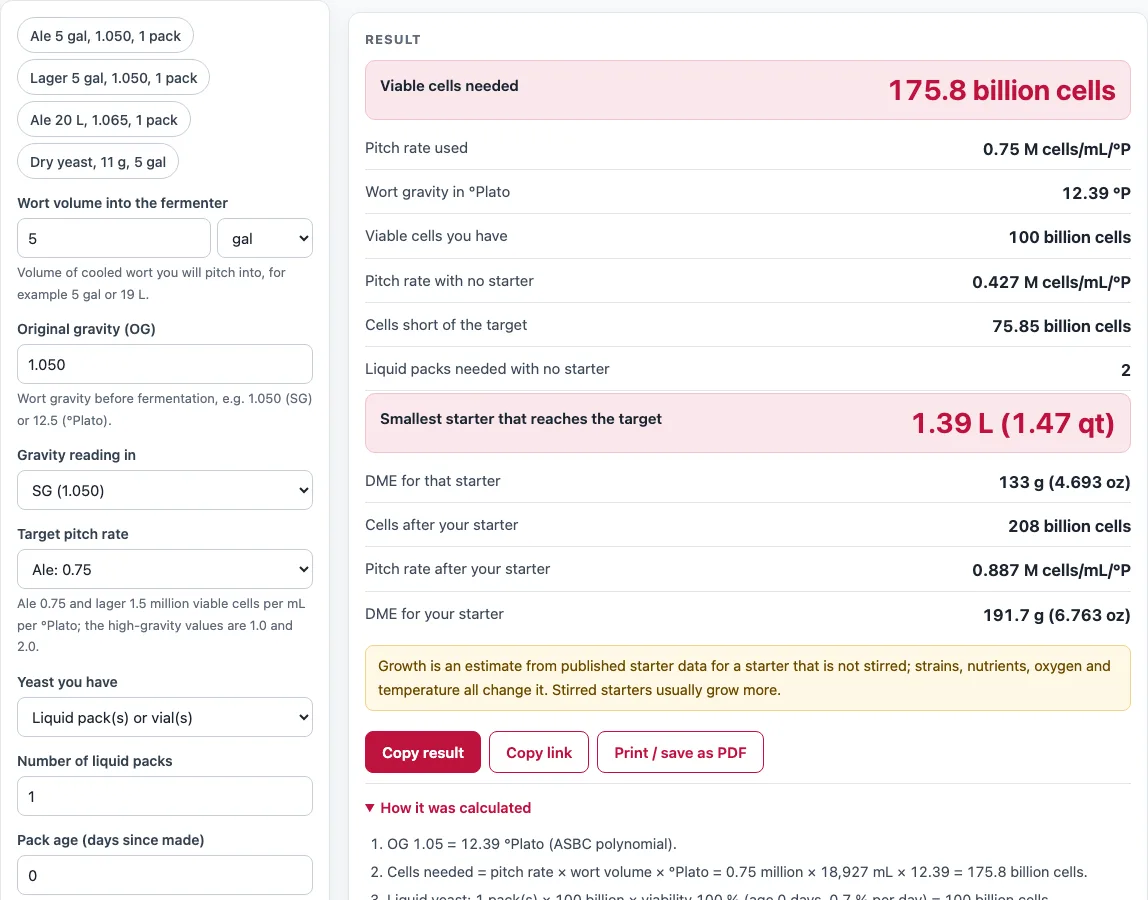
How to use the Yeast Starter Calculator
- Enter the wort going into the fermenter in “Wort volume into the fermenter” and choose gal, L, qt or mL.
- Enter “Original gravity (OG)” and pick “SG (1.050)” or “°Plato” in “Gravity reading in”. SG must be 1.005 to 1.150, and °Plato 1 to 35.
- Choose a style under “Target pitch rate”: Ale, High-gravity ale, Lager, High-gravity lager or Custom. For Custom, type a rate above 0 and up to 5 in “Custom pitch rate”.
- Under “Yeast you have”, choose Liquid pack(s) or vial(s), Dry yeast, or A known cell count.
- Fill in the matching fields: “Number of liquid packs” and “Pack age (days since made)”, or “Dry yeast (grams)”, or “Viable cells you have (billion)”.
- Read “Cells short of the target”. The page then shows the packs or grams needed with no starter, or “Smallest starter that reaches the target” with its “DME for that starter”.
- To test your own starter, set “Starter volume” (default 2 L) and, under More options, “Starter wort gravity (SG)” (default 1.036). Read “Cells after your starter”.
The four preset buttons load example batches you can change. “Copy link” keeps your inputs, “Copy result” copies the results, “Print / save as PDF” prints the page, and “Reset” clears the form. “How it was calculated” shows each step with your numbers.
How many yeast cells do I need to pitch for my batch?
Multiply the pitch rate by the wort volume in mL and by the gravity in °Plato, then divide by 1000. The answer is in billion cells. A 5 gal ale at 1.050 (about 12.39 °P) at a pitch rate of 0.75 needs 175.8 billion cells.
The pitch rate is in million viable cells per mL per °P. Ale uses 0.75 and lager 1.5, from George Fix as used by Mr Malty. High-gravity ale (1.0) and high-gravity lager (2.0) come from Brewer’s Friend’s list. Above 15 °P (about 1.061) the tool warns that the beer counts as high gravity.
How big a yeast starter do I need?
The smallest starter is the volume at which one step grows your yeast to the cells you need. The growth model is cells after = cells × (1 + G). G depends on billions of cells per litre of starter, is capped at 6, and is zero at 200 billion per litre or more. It is Brewer’s Friend’s fit of Chris White’s data.
For the 5 gal ale with one fresh 100-billion pack, the smallest starter is 1.39 L. If the target is more than 7 times the cells you have, one starter cannot reach it, and the tool says so.
How much DME for a yeast starter?
DME grams = (SG − 1) × 1000 × litres × (453.59 g/lb / 3.7854 L/gal) / 45, using 45 points per pound per gallon. At 1.036, 1 L needs 95.9 g of DME, close to Mr Malty’s rule of 1 g per 10 mL.
Does yeast viability drop with age?
Yes. The tool estimates that liquid yeast loses 0.7% of its viable cells per day, about 21% per month. White Labs gives 75 to 85% after 30 days, and the model gives 79%. A pack 143 days old or more gives an error because the estimate reaches zero. A cell count is better if you have one.
Does a stir plate make a bigger starter?
Stirred starters usually grow more than unstirred ones. This tool has no stir-plate model: its growth curve is a fit to Chris White’s data, which Kai Troester (Braukaiser) says looks like an unstirred starter. Treat the starter results as a planning estimate, and expect a stirred starter to grow more.
Sources
- Mr Malty, Proper Yeast Pitching Rates — ale 0.75 and lager 1.5 million cells per mL per °Plato (George Fix), starter gravity 1.030–1.040 and about 1 g DME per 10 mL, 100 billion cells in a Wyeast pack, example 180 billion cells for 12 °P in 20 L
- Brewer’s Friend, Yeast Pitch Rate and Starter Calculator — high-gravity pitch rates, liquid viability falling 0.7 % per day, dry yeast cells per gram, DME at 45 points per pound per gallon, and the fit to Chris White’s starter growth data (White and Zainasheff, Yeast, 2010, pp. 139–44, as documented there)
- Braukaiser, Yeast growth experiments – some early results — why published growth data looks like unstirred starters and why stirred ones grow more (archived copy)
Worked examples
| Input | Result |
|---|---|
| 5 gal, OG 1.050 SG | 175.8 billion cells needed, smallest starter 1.39 L (1.47 qt) |
| 20 L, OG 1.065 SG | 477.1 billion cells needed, smallest starter 12.2 L (12.9 qt) |
| 5 gal, OG 1.050 SG | 175.8 billion cells needed, smallest starter 2.26 L (2.39 qt) |
Calculated by the tool above with these values.
Frequently asked questions
Do I need a starter for lager?
For a 5 gal lager at 1.050 with one fresh 100-billion pack, the tool shows you are short. The smallest starter that reaches the target is 6.28 L with 601.6 g (21.22 oz) of DME. Without a starter you would need 4 packs.
How many packs of yeast do I need without a starter?
Divide the cells needed by the viable cells in each pack, and round up. The tool shows this as “Liquid packs needed with no starter”. For 5 gal ale at 1.050 with fresh packs you need 2 packs, and for 20 L ale at 1.065 you need 3.
How much dry yeast should I pitch?
The tool assumes 6 billion viable cells per gram, a cautious figure since published minimums range from 5 to 10 billion per gram. For 5 gal ale at 1.050 it gives 29.3 g of dry yeast with no starter, and the default 11 g gives 66 billion cells. Change the figure under More options if your pack states one.
What gravity should a yeast starter be?
The default starter gravity is 1.036 SG, the gravity the growth fit is for. The tool accepts 1.020 to 1.060 and warns when the value falls outside 1.030 to 1.040. Check the DME figure after you change it.
Is the calculator free, and is anything I type uploaded?
Yes, the calculator is free and runs in your browser. Nothing you type is uploaded, and no sign-up is needed. All results are estimates.
Related tools
- Beer recipe calculator: use this to plan the full batch before you size the yeast.
- Original gravity calculator: use this to correct a hydrometer reading taken at a non-standard temperature before you enter it as OG.
- Brix to SG calculator: use this to convert a refractometer reading to specific gravity before you enter it here.
- ABV calculator: use this to estimate alcohol content from your original and final gravity.
- All calculators: use this to browse every tool on the site.